
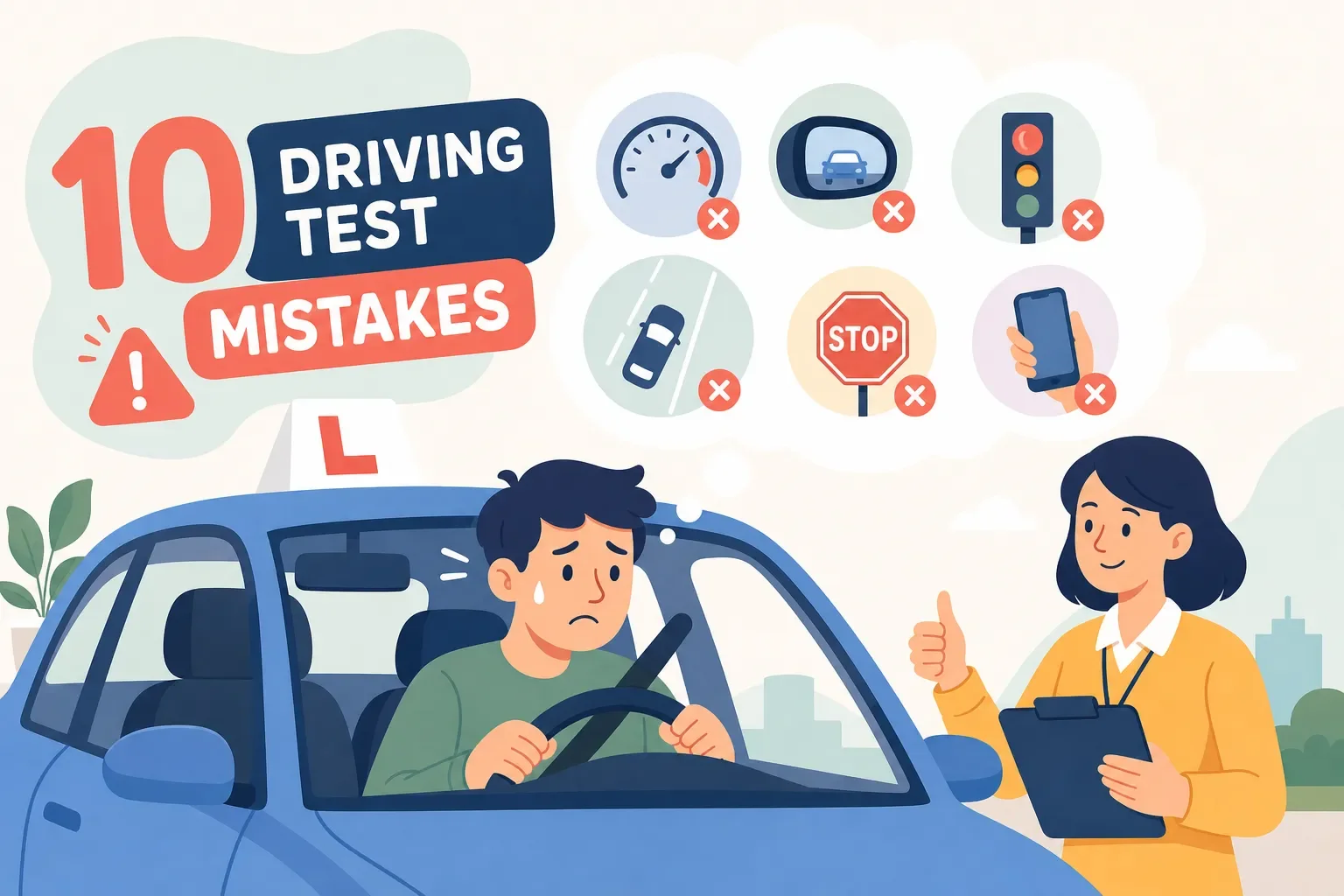
10 Common Driving Test Mistakes (And How to Avoid Them)
Roughly 4 in 10 first-time test-takers don't pass their driving test on the first attempt. That number surprises most people, especially students who've spent weeks behind the wheel with a parent in the passenger seat. The reason for those failures is almost never nerves. It's a short, repeatable list of mistakes that examiners see every single day, and every one of them is fixable before your test date.
This guide breaks down all 10 of those mistakes, explains exactly what the examiner is watching for, and shows you how to correct each one before you show up at the DMV. Programs like ICT North Star Driving Academy in Wichita are built around these exact evaluation criteria, which is why structured instruction converts to a passed driver's license test far more reliably than unguided practice loops around the neighborhood.
What examiners score before you even pull into traffic
Before your foot touches the gas, the examiner is already evaluating you. Two of the most common DMV driving test failures happen in the first five minutes and have nothing to do with driving skill.
Mistake 1: Missing documents or a vehicle that won't pass inspection
Required documents for a road test typically include your valid learner's permit, proof of insurance, vehicle registration, and any course completion certificates your state requires. In Kansas, teen drivers should also bring a parent or guardian's signed consent form and proof of Kansas residency, and if you're still working toward your permit, make sure your permit test is fully squared away before you schedule the road test. A vehicle with broken brake lights, a cracked windshield in the driver's sightline, or a non-functioning horn can be rejected outright before you ever move the car. Build a driving test checklist the night before: documents, vehicle condition, fuel level, and every light. Check all of it before you leave the house.
Mistake 2: Skipping the pre-drive vehicle check
Many states require you to demonstrate basic familiarity with the vehicle's controls before the drive begins. Fumbling for the defroster or stalling when asked to activate hazard lights signals a lack of preparation to the examiner. Spend five minutes in the driver's seat before your appointment and locate every control: wipers, horn, emergency flashers, defrost, and lights. Know where everything is, not just the controls you use on a daily basis.
The observation habits examiners score most heavily on the driving test
Observation is the single biggest differentiator between students who pass and those who don't. Examiners are trained to watch your head movement, your eyes, and your response time to everything around you. Two mistakes in this category account for a disproportionate share of road test failures.
Mistake 3: Not checking mirrors and blind spots on every maneuver
Mirror and blind spot checks are not optional extras. Examiners expect you to glance at your mirrors approximately every 8 to 10 seconds during normal driving, signal before every lane change or turn, and physically turn your head to scan blind spots before merging. Students who rely only on mirrors without the head-turn get marked down every time. Make it a muscle-memory habit before test day, not a checklist item you try to remember under pressure.
Mistake 4: Rolling through stop signs
A complete stop means the vehicle reaches zero forward motion before the stop line. Rolling stops, where the car slows but never fully halts, are one of the most common automatic-fail triggers on a behind-the-wheel test. Count one full second after you feel the car reach a complete stop. Then scan left, right, left before you move. It adds two seconds and eliminates one of the most avoidable deductions on the test.
Speed, braking, and lane control errors on the driving test
Vehicle control mistakes tend to cluster together. A student who rushes one maneuver usually rushes all of them. Three specific errors in this category show up repeatedly in examiner feedback, and each one has a clear, trainable fix.
Mistake 5: Driving too fast or too slow for conditions
Examiners penalize both extremes. Driving 10 mph below the posted limit in a residential zone with no hazard present signals a lack of confidence. Pushing above the limit, even by a small margin, signals a lack of discipline. Match your speed to posted limits and road conditions. When you're unsure, default to what feels controlled and natural, not so cautious that you hesitate through every decision.
Mistake 6: Harsh braking and abrupt steering
Jerky braking and overcorrected turns tell the examiner you are reacting rather than anticipating, and examiners notice the difference immediately. Brake early and progressively, and begin your turns with gradual steering input rather than a sharp wheel-jerk. If you're practicing in a parking lot, prioritize the smoothness of each maneuver over the speed at which you complete it.
Mistake 7: Wide turns and lane drift
A right turn should end in the right lane. A left turn should end in the left lane. Swinging wide across lane boundaries earns an immediate deduction on most road skills tests. During straight-line driving, keep your eyes focused at least 10 to 12 seconds down the road ahead of you. New drivers who stare at the hood of the car tend to drift. Look further ahead and lane position holds itself naturally.
Where parking and reversing maneuvers go wrong
Parking is the maneuver most new drivers dread, and that anxiety causes most of the mistakes. Examiners aren't expecting perfection on parallel parking. They're watching your process: your observation, your control, and your final positioning relative to the curb.
Mistake 8: Rushing parallel parking under pressure
The three most common parallel parking failures are finishing too far from the curb, ending at an angle, and skipping mirror and blind spot checks throughout the maneuver. Most states require a final position within 18 inches of the curb. Rushing is the root cause of all three errors. Parallel parking at test speed should feel almost slow. Use your reference points, check your mirrors at each direction change, and straighten out gradually. If your state allows a repositioning move, take it rather than accepting a crooked final position.
Mistake 9: Poor backing technique
Backing maneuvers, including straight-line reversing and three-point turns, penalize students who look only in mirrors. Examiners expect you to turn and look over your shoulder as your primary view of the path behind the vehicle, using mirrors as a supplement rather than a substitute. In a three-point turn, check traffic at each direction change before you move. Students who skip these checks during backing maneuvers fail the same way they fail on blind spot checks: they know the rule but don't execute it when it counts.
Intersection and lane change mistakes that signal inexperience
Intersections and lane changes are where traffic decisions happen at full road speed, which makes mistakes more visible and more consequential. One poor decision in this category can stack multiple deductions in a matter of seconds.
Mistake 10: Improper signaling, unsafe gaps, and yielding errors
Three of the most frequently cited failure points on a driver's license test fall in this category: failing to signal before a lane change, merging into a gap that is too small, and not yielding to oncoming traffic on a left turn. Each reflects the same underlying issue, the student is reacting to what's immediately in front of them instead of reading the full intersection. Signal at least 100 feet before any turn or lane change. Check mirrors, check blind spots, then move. At intersections, yield when in doubt, especially on left turns where oncoming traffic holds the right-of-way.
The real fix: supervised practice with expert feedback
All 10 mistakes share a common root cause: not enough quality repetition on real roads with someone who knows the evaluation criteria. Practicing the same routes with a parent who doesn't know the scoring sheet won't prepare you for what the examiner actually watches. You need someone who can identify the gaps in real time and correct them before bad habits become automatic.
A practice driving test in an empty parking lot feels nothing like navigating a signalized intersection at 35 mph with a stranger scoring your every head turn. Students who log hours without deliberate feedback tend to reinforce mistakes rather than correct them. Quality beats quantity, every time.
How ICT North Star Driving Academy prepares students for every skill on the driving test
ICT North Star Driving Academy in Wichita offers 6 hours of behind-the-wheel training with licensed instructors who work through every maneuver covered on the Kansas road test, from mirror-check habits and parallel parking execution to intersection judgment and lane changes. The IPDE method taught in the curriculum (Identify, Predict, Decide, Execute) directly addresses the observation and judgment gaps that cause most test failures. Instructors ride along, evaluate in real time, and correct technique before it becomes a pattern. Students will take their driving exam with the same instructor they do their behind-the-wheel training with. The 6 hours of training with personalized lessons will help each student driver gain confidence and master all of the necessary skills needed to meet all state requirements. If there are driving maneuvers the student needs to improve upon, their instructor will structure lessons to help students master each task and recommend ways student can practice prior to their exam. Students who meet all course requirements will receive a Certificate of Completion that will waive the written and driving exams at the DMV. Contact the ICT North Star team to schedule your behind-the-wheel sessions and avoid the pressure of testing with a stranger at the DMV.
Every driving test mistake on this list is fixable before your appointment
Every mistake covered here is correctable with focused practice. Most come down to observation habits, smooth vehicle control, and enough deliberate repetition with real feedback. Work through this list as a self-assessment. If you can execute each skill consistently under real traffic conditions and real pressure, you're ready.
If gaps remain, fill them with structured instruction rather than more unguided laps. The driving test isn't a mystery. It rewards exactly the habits that quality driver's education is designed to build, and those habits are learnable before your appointment date.
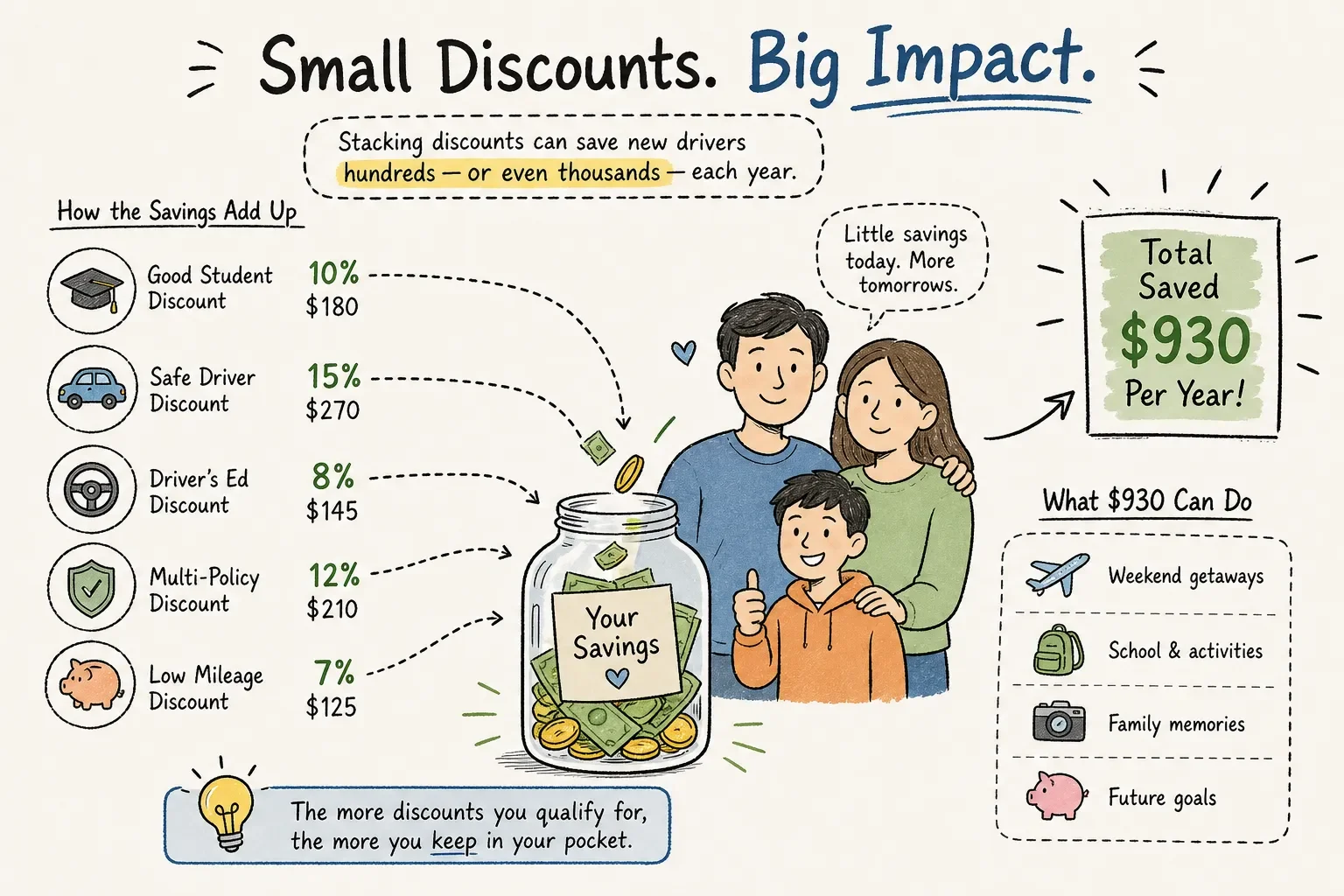
Car insurance discounts for new drivers that actually work
New driver insurance is expensive, that part isn't a secret. What most families don't realize is how many legitimate car insurance discounts for new drivers are sitting unclaimed, not because they're complicated to get, but because nobody walked them through what to ask for or what paperwork to hand over. Working with families in the Wichita area through programs like ICT North Star Driving Academy, one pattern comes up constantly: the Certificate of Completion a student earns after finishing a state-licensed driver's ed course gets filed away or handed to the DMV, and that's the end of it. Nobody tells the family it has a second job to do at the insurance company. Understanding which car insurance discount new driver programs exist, and how to claim them, can save families hundreds of dollars annually.
That's the gap this article fills. You'll find out which discounts exist, roughly how much each one saves, whether to add your teen to your existing policy or buy separate coverage, and the exact documentation that makes each discount stick when you submit it.
New driver insurance is expensive, that part isn't a secret. What most families don't realize is how many legitimate car insurance discounts for new drivers are sitting unclaimed, not because they're complicated to get, but because nobody walked them through what to ask for or what paperwork to hand over. Working with families in the Wichita area through programs like ICT North Star Driving Academy, one pattern comes up constantly: the Certificate of Completion a student earns after finishing a state-licensed driver's ed course gets filed away or handed to the DMV, and that's the end of it. Nobody tells the family it has a second job to do at the insurance company. Understanding which car insurance discount new driver programs exist, and how to claim them, can save families hundreds of dollars annually.
That's the gap this article fills. You'll find out which discounts exist, roughly how much each one saves, whether to add your teen to your existing policy or buy separate coverage, and the exact documentation that makes each discount stick when you submit it.
Why new driver insurance costs what it costs
The risk profile insurers are actually pricing
Teen and new drivers are involved in accidents at significantly higher rates than experienced drivers. This isn't a judgment call by insurers; it's documented in crash data year after year. When an insurer sees a 16-year-old on a policy, they're pricing against a real statistical risk, not a stereotype. Understanding that framing matters because the entire discount conversation is about demonstrating lower risk, not just asking for a better deal.
What that means for your premium
Adding a teen to a parent's policy can increase the annual premium by roughly $2,700 to $4,500 depending on the insurer and the teen's age. A young adult buying their first standalone policy faces even steeper pricing because they lack the established history that earns better rates over time. The only real lever available to families is showing evidence of lower risk. Discounts are the formal mechanism insurers use to recognize that evidence, and most families don't take full advantage of them.
Car insurance discounts for new drivers: what you'll actually qualify for
Good student discount
Full-time students carrying a B average (3.0 GPA) or better qualify for the good student discount at most major carriers. Savings typically fall between 5% and 25% depending on the insurer. The documentation is straightforward: a recent report card or official transcript. Some carriers also accept an honor roll letter or a school verification form from the registrar's office.
Driver education discount
This is the most consistently overlooked discount in the category. Completing a state-approved driver's education course qualifies the driver for a formal rate reduction at many major insurers, with savings generally running 5% to 15%. The catch is that the discount doesn't apply automatically. The insurer needs specific documentation to process it, and most families never submit it because they assume the DMV paperwork is the end of the story. It isn't.
Usage-based insurance programs
Telematics programs are available to all drivers but carry outsized value for teen driver insurance situations where the driver is genuinely careful behind the wheel. An app or plug-in device tracks braking, acceleration, speed, time of day, and phone use. Strong driving scores can save up to 30% at some carriers, and many programs offer an enrollment discount just for signing up before any driving data is collected.
Multi-car and bundling discounts
Families with more than one vehicle on a policy, or those who bundle auto coverage with home or renters insurance, typically save an additional 5% to 20%. These discounts stack cleanly on top of student and driver education discounts, which is where the real compounding happens.
How the driver's education discount actually works
Which insurers offer it and what they pay out
Most major carriers offer some version of a driver's education discount. Progressive typically falls in the 5% to 10% range for qualifying drivers. GEICO averages around 10%, with some approved courses pushing toward 15%. State Farm and others generally land in the 5% to 15% range depending on the state and the driver's age. On a premium that's already elevated because of the driver's age, even 10% represents real money annually.
The Certificate of Completion: what it is and why it matters here
State-approved driver's education programs issue a Certificate of Completion when a student finishes the course. This is the document an insurer needs to process the driver's education discount. A certificate issued by a school like ICT North Star Driving Academy, which is state-licensed and recognized by the Kansas DMV, includes the student's name, the course title, and the completion date: the three pieces of information underwriters typically ask for. Families who complete the program and never submit this certificate to their insurer are leaving a 5% to 15% discount on the table because of one overlooked step.
What "state-approved" means for discount eligibility
Not every driving course qualifies for the insurance discount. Insurers specify that the program must be state-licensed or state-approved. A course completed at a school that doesn't meet state requirements won't generate a qualifying certificate, and the discount won't apply regardless of what you submit. This distinction matters when choosing a driver's ed program in the first place. State approval affects your discount eligibility, not just your DMV paperwork.
Stacking discounts: telematics, good grades, and bundling
How telematics programs work for new drivers
Usage-based insurance rewards actual driving behavior rather than driving history. For a new driver with no accidents or violations on record, these programs offer a fast path to meaningful cheap insurance for new drivers. Most programs deliver an enrollment discount immediately when you sign up, then calculate a personalized rate adjustment based on real driving data collected over a set period. A new driver who brakes smoothly, stays within speed limits, avoids late-night driving, and keeps the phone down can realistically reach the 25% to 30% savings tier at several major carriers.
Combining the good student discount with driver ed savings
These two discounts target entirely different criteria and can apply simultaneously. A student with a B average who also holds a Certificate of Completion from an approved driver's education program qualifies for both. On a premium that's already elevated due to age, stacking two separate discounts compounds the reduction in a way that changes the annual cost meaningfully rather than just trimming it at the edges.
Why the math works better when you combine discounts
A single 10% discount on a $3,000 annual premium saves $300. Layer a 15% telematics result on top of a 10% driver's ed discount and the combined reduction approaches $700 to $750 annually. The discounts don't cancel each other out; they apply together, and most insurers allow multiple qualifications on a single policy. State Farm, for example, advertises up to 25% for good grades, a teen driver training discount, and up to 30% through their Drive Safe and Save telematics program. The combined ceiling for a well-documented teen driver is significant.
Parent's policy vs. separate coverage: what the numbers actually show
Why adding a teen to a parent's policy is usually the cheaper path
Adding a teen to an existing parent policy increases that premium, sometimes sharply. Estimates for a 16-year-old average around $2,700 to $3,600 per year in added cost, depending on the carrier and state. But a standalone policy for a teen with no insurance history costs even more, because a first-time policyholder can't access the established history, bundled discounts, and multi-car structures already built into a parent's policy. The parent's policy starts at a lower baseline and has more discount eligibility to offset the increase.
When separate coverage might make sense
If the teen owns a vehicle in their own name, or if the parent's insurer requires an exclusion for specific household circumstances, a separate policy becomes necessary. For most families in a standard situation, this is the exception. Start with the existing household policy. Add the teen, apply every discount that qualifies, and only consider a separate policy if the insurer or ownership situation forces the issue.
How discounts change this calculation
A teen added to a parent's policy who qualifies for the driver's ed discount, the good student discount, and a telematics program can offset a meaningful portion of that $2,700 to $3,600 premium increase. The discounts don't just help at the margins. For some families, they're the difference between an affordable addition and one that breaks the monthly budget.
Car insurance discount for new drivers: the documentation checklist
Good student discount: what to submit
A recent report card or official school transcript showing a B average or better is the standard requirement. Some carriers also accept an honor roll letter or a signed school verification form. Homeschool families should contact their insurer directly to ask what alternative documentation qualifies. Most carriers have a process for it, but you have to ask.
Driver education discount: the Certificate of Completion
This is the document that unlocks the driver's education discount. It must come from a state-licensed program. A Certificate of Completion issued by ICT North Star Driving Academy includes the student's name, the course title, and the completion date, exactly what insurers ask for when processing this discount. Submit it directly to your insurance agent or upload it through the carrier's online portal when adding or updating a driver on the policy. Do it at the time the driver is first added, or at your next renewal at the latest. Don't wait for the insurer to prompt you; they won't.
Telematics programs: enrollment confirmation and usage data
To qualify, you need to formally enroll in the program, activate the app or install the plug-in device, and participate through the designated tracking period. Enrollment confirmation comes from the insurer or the app itself after sign-up. The final discount is calculated from driving data collected during participation, so the documentation is generated through the program rather than submitted separately. The key action is enrolling when the teen is first added to the policy, not months later.
When to submit and who to contact
Submit all discount documentation when first adding the new driver to the policy or at the next renewal if the driver is already listed. Contact your agent directly rather than waiting for a prompt. Insurers don't proactively ask for documentation that could lower your bill; the responsibility to initiate sits entirely with the policyholder. A five-minute call or email with the right documents attached is all it takes to activate discounts that can save hundreds of dollars annually.
The bottom line on new driver discounts
New driver insurance is expensive, but it isn't fixed. The discounts are real, the savings are meaningful, and the documentation is simpler than most families expect. The Certificate of Completion from a state-approved driver's education program is one of the most underutilized documents a family holds after finishing a course. Its value at the insurance company is just as real as its value at the DMV, and most families only use it for one of those two purposes.
If you're in the Wichita area and your teen is starting the driver's ed process, ICT North Star Driving Academy's state-licensed program issues exactly the Certificate of Completion that insurers require. The classroom hours, behind-the-wheel training, and Kansas DMV recognition all work together, and the certificate you walk away with has a job to do at your insurance company after the course is done.
Stack the car insurance discounts for new drivers that you qualify for. Submit the documentation when you add the driver to the policy. Don't leave savings on the table, the discounts are there, but nobody's going to activate them without the paperwork to back them up. Use this checklist to secure every car insurance discount your new driver is entitled to.
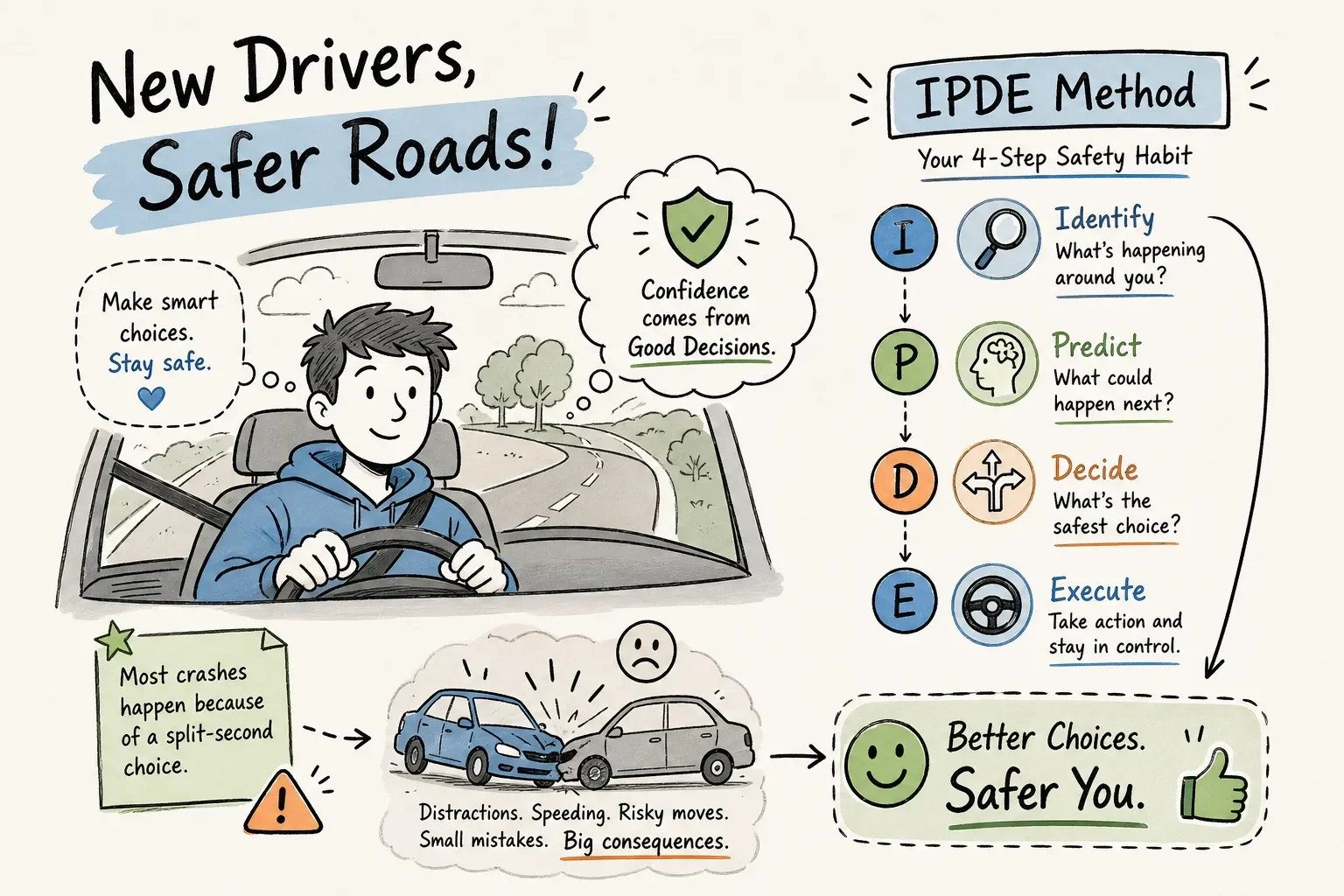
How the IPDE Method Helps New Drivers Avoid Crashes
Picture this: you're a brand-new driver sitting at a busy intersection. Your hands are tight on the wheel. The light is green, but traffic is moving in multiple directions, a pedestrian is stepping off the curb to your right, and a car is creeping forward from the cross street. You're not sure where to look first, and for a half-second, you freeze.
That moment isn't a sign that you're not cut out for driving. It's a sign that your brain doesn't have a system yet. Most new drivers look at the road the same way they watch a TV show: they wait for something to happen and then react to it. The problem is that by the time a hazard is fully visible, the window for a smooth, controlled response has already started to close.
So how does the IPDE method help new drivers avoid accidents? The IPDE method, which stands for Identify, Predict, Decide, Execute, is the structured thinking loop that experienced drivers run almost automatically on every block. It's not instinct; it's a learned framework. And the good news is that it can absolutely be learned, practiced, and turned into a habit. This article walks through each step in plain language, shows you how IPDE helps new drivers avoid accidents across real driving situations, gives you practical drills to use on your very next practice drive, and wraps up with a simple checklist to use every time you get behind the wheel.
Picture this: you're a brand-new driver sitting at a busy intersection. Your hands are tight on the wheel. The light is green, but traffic is moving in multiple directions, a pedestrian is stepping off the curb to your right, and a car is creeping forward from the cross street. You're not sure where to look first, and for a half-second, you freeze.
That moment isn't a sign that you're not cut out for driving. It's a sign that your brain doesn't have a system yet. Most new drivers look at the road the same way they watch a TV show: they wait for something to happen and then react to it. The problem is that by the time a hazard is fully visible, the window for a smooth, controlled response has already started to close.
So how does the IPDE method help new drivers avoid accidents? The IPDE method, which stands for Identify, Predict, Decide, Execute, is the structured thinking loop that experienced drivers run almost automatically on every block. It's not instinct; it's a learned framework. And the good news is that it can absolutely be learned, practiced, and turned into a habit. This article walks through each step in plain language, shows you how IPDE helps new drivers avoid accidents across real driving situations, gives you practical drills to use on your very next practice drive, and wraps up with a simple checklist to use every time you get behind the wheel.
Why new drivers freeze when traffic gets complicated
The cognitive overload problem behind the wheel
When you're brand new to driving, your brain is busy. Steering smoothly, managing the gas and brake, staying in your lane, watching your mirrors, none of that is automatic yet. Each of those tasks takes up conscious mental effort, which means there isn't much room left to scan for hazards at the same time. Experienced drivers handle all of those things without thinking, which frees up mental bandwidth for reading the road ahead.
This is not a character flaw or a sign of poor driving ability. It's a predictable stage in skill development. Every driver goes through it. The difference between drivers who stay stuck at this stage and drivers who move past it quickly is whether they have a framework for hazard perception, or whether they're simply logging hours and hoping the skill develops on its own.
What experienced drivers actually do differently
Experienced drivers aren't faster to react. They're earlier to anticipate. By the time a hazard becomes a crisis, a seasoned driver has already seen it developing, already predicted what it might do, and already taken a small action to create more room and time. The "close call" that shakes a new driver often never registers as a crisis for an experienced driver because it was managed two seconds before it became one.
That earlier awareness is exactly what the IPDE process trains. It teaches the mind to look ahead systematically, reading what is about to happen rather than reacting to what has already appeared. Learning this framework early, before reactive habits calcify, is one of the main reasons programs like ICT North Star Driving Academy build IPDE into both the classroom curriculum and every behind-the-wheel session from the very first day.
How the IPDE method helps new drivers avoid accidents: a step-by-step breakdown
Identify and Predict: the perception half
Identify means actively scanning your environment, not just staring at the car ahead of you. It includes looking 12 seconds ahead on the road, checking your mirrors every five to eight seconds, scanning curbs and sidewalks, reading road-surface conditions, and spotting signs and signals before you're right on top of them. The key word is "actively." Passive looking waits for a hazard to present itself. Active scanning goes looking for it. Those are two very different habits, and only one of them reduces crash risk.
Predict is where the real defensive driving happens. Every object you identify gets a question: what could that thing do next? The parked car with a driver inside might suddenly open its door. The child on the sidewalk might dart into the street. The vehicle rolling slowly toward the stop line might not stop in time. Prediction is the step that buys you time, and it's also the step most new drivers skip entirely, jumping straight from seeing a hazard to reacting to it. Some curricula refer to this expanded version as the SIPDE method, which adds an explicit "Scan" step before Identify. The underlying idea is identical: build a full mental picture before a conflict develops.
Decide and Execute: the response half
Decide means choosing a specific action before the hazard closes in on you. Reduce speed. Cover the brake. Adjust your lane position slightly. Signal your intention. Commit to a specific response rather than hoping the situation resolves itself. The quality of your decision is directly tied to how early you ran the Identify and Predict steps. A good decision made early is a calm one. A decision made late is usually a desperate one.
Execute is the physical part: carrying out your chosen action smoothly. Gradual brake pressure instead of a hard stomp. A controlled steering adjustment instead of a panic swerve. A deliberate lane change with a signal and shoulder check instead of a sudden dart across lanes. Smooth execution is only possible when the first three steps happened early enough to give you time and space to act without rushing.
How IPDE helps new drivers avoid accidents: three everyday scenarios
Scenario 1: approaching a signalized intersection
You're approaching a green light when you spot a car to your left rolling slowly toward the stop line on the cross street. That's your Identify step. You Predict that the vehicle may not stop in time. So you Decide to cover your brake pedal and ease off the accelerator slightly. Then you Execute a smooth, gradual reduction in speed that gives you extra stopping distance before you even reach the intersection. If you had skipped Identify and Predict, you'd still be at full speed when the situation became a crisis, leaving a hard, late brake as your only option.
Scenario 2: driving past parked cars on a residential street
You Identify a parked car with a person visible in the driver's seat. You Predict two possibilities: the door may swing open, or the car may pull into traffic. You Decide to shift your position slightly toward the center of your lane and ease your speed. Then you Execute a smooth lateral adjustment, no sudden swerving, no horn. This is the "dooring zone," and it catches new drivers off guard regularly. Not because it's unpredictable, but because most new drivers haven't been trained to predict it until a close call teaches them the hard way.
Scenario 3: merging onto a highway
Highway merging compresses all four IPDE steps into a short window while your speed is still increasing, which is what makes it one of the most demanding situations for new drivers. You Identify the gap in traffic and the closing speed of the vehicle behind that gap. You Predict whether the gap will hold long enough for a safe merge, then Decide on your timing and match your speed to traffic. You Execute with a signal, a shoulder check, and a smooth steering input into the lane. Running through all four steps in sequence, in real time, at speed, that's exactly the kind of situation that needs to feel automatic before a new driver encounters it independently.
Drills that make IPDE feel automatic
The commentary driving drill
This is arguably the most effective IPDE drill available, and it costs nothing. The driver narrates everything aloud while driving: what they see, what they think might happen, and what they plan to do. "I see a car at the driveway on my right. I think it might pull out. I'm going to ease off the gas and cover my brake." Speaking the loop out loud forces the Identify-Predict-Decide sequence to run consciously, and it makes gaps in the driver's scanning immediately visible to both the driver and the person in the passenger seat.
Suggested format: 10 to 15 minutes on a familiar, low-traffic route, once a week during the early weeks of supervised practice. The goal isn't to talk forever; it's to build the habit of running the mental loop before external events force a reaction.
The what-if prediction drill
The instructor or parent asks short prompts at key moments during the drive: "What if that car at the driveway pulls out right now?" "What if the pedestrian steps off the curb?" "What if the light goes yellow before you reach it?" The driver has to answer with a specific planned action, not a shrug. This drill targets the Predict step directly, which is the step most beginners skip. When you make prediction a verbal, active exercise rather than a background assumption, it starts showing up automatically during solo drives. Try running this drill for at least one 15-minute session per week during the first month of practice.
The three-second following distance drill
Pick a fixed roadside landmark, a sign or a tree works well, and start counting when the car ahead passes it: "one-one-thousand, two-one-thousand, three-one-thousand." If your front bumper reaches that landmark before you finish counting, you're following too closely. This drill reinforces the Execute step in a concrete, repeatable way. Maintaining a consistent following distance is one of the most reliable crash-avoidance actions available to any driver, and it requires all four IPDE steps working together: identifying the gap, predicting whether it's adequate, deciding to adjust, and smoothly executing the change in speed.
Why structured training makes IPDE stick faster
Classroom instruction lays the mental foundation
Before a new driver can apply IPDE on a live road, they need to understand the framework conceptually: what counts as a hazard, how far ahead to look, and how to think through a decision when time is short. That conceptual work happens in the classroom, not behind the wheel. At ICT North Star Driving Academy, the 8-hour classroom curriculum introduces the IPDE method alongside Kansas-specific traffic laws, road-sign recognition, and hazard scenarios. Students arrive at their first behind-the-wheel session with the mental framework already in place, not trying to learn a thinking system while also managing a moving vehicle.
Behind-the-wheel training vs. practicing with a parent
A parent riding along is genuinely valuable for building practice hours, but there's a real difference between how a parent teaches and how a licensed instructor teaches. Parents typically teach by correction: they notice a mistake after it happens and describe it afterward. A licensed instructor teaches by anticipation: they prompt the prediction before the hazard arrives, catch a scanning gap before it becomes a problem, and build decision-making habits during the drive rather than in the debriefing afterward.
ICT North Star Driving Academy's 6 hours of behind-the-wheel instruction are built around active IPDE coaching in real Wichita traffic. Instructors ask prediction prompts at intersections, identify where a student's scan breaks down, and reinforce the full Identify-Predict-Decide-Execute loop in real time. That kind of guided repetition is what turns a framework a student memorized in class into a reflex they use without thinking. Parents can absolutely help reinforce those skills at home, but the foundation is laid by someone trained to teach anticipation rather than just catch errors.
Your IPDE checklist for every practice drive
Before you leave the driveway
Take 60 seconds before you start the car to set a mental intention for the drive. Run through a few quick questions: What route am I driving, and what high-risk zones will I encounter, school zones, busy intersections, or highway on-ramps? Which IPDE step am I specifically going to focus on today? What am I going to look for that I might normally miss? This isn't a formal ritual; it's a mindset shift. Entering the car with an active, searching mindset is a fundamentally different starting point than simply getting in and going.
During and after every session
In the early weeks, focus on one IPDE step per drive instead of trying to do everything at once. Week one: practice Identify only, naming every hazard you spot out loud. Week two: add Predict, asking "what might that do next?" for each hazard. Week three: layer in Decide. Week four: evaluate your Execute, noticing whether your responses are smooth or rushed. This progressive approach mirrors how structured driver's education programs build skill across classroom sessions and driving lessons without overwhelming a new driver all at once.
After each session, run a quick debrief: What hazard did I identify early that I might have missed a week ago? Did my prediction match what actually happened? What would I decide differently next time? The IPDE process is not about being a perfect driver from the first lesson. It's about building the habit of looking earlier and thinking one step ahead so that time and space are on your side when a situation develops. That habit compounds with every single drive.
The same intersection, a different driver
Go back to that busy intersection from the opening. The same cars, the same pedestrian, the same complicated moment. But this time, the driver spotted the cross-traffic vehicle two blocks back. They predicted it might creep through the stop line. They covered the brake before reaching the intersection. The situation hasn't changed; the driver is just ready for it. That's how the IPDE method helps new drivers avoid accidents: it doesn't make the road less complicated, it makes you less surprised by it.
The four steps, Identify, Predict, Decide, Execute, aren't a checklist you read once. They're a loop you run on every block, in every parking lot, at every merge and intersection. The drills and checklist in this article are a real starting point for building that habit, but the fastest way to make IPDE automatic is to practice it with an instructor who can catch what you're missing in real time.
If you're in the Wichita area and want to learn why IPDE helps teen drivers avoid accidents, and build those skills the right way, ICT North Star Driving Academy's state-approved program is built around exactly this kind of IPDE-based instruction. Classroom sessions introduce the framework, and behind-the-wheel sessions put it into practice in real local traffic, with a licensed instructor beside you. Visit ICT North Star Driving Academy's website to learn more and schedule your first session.
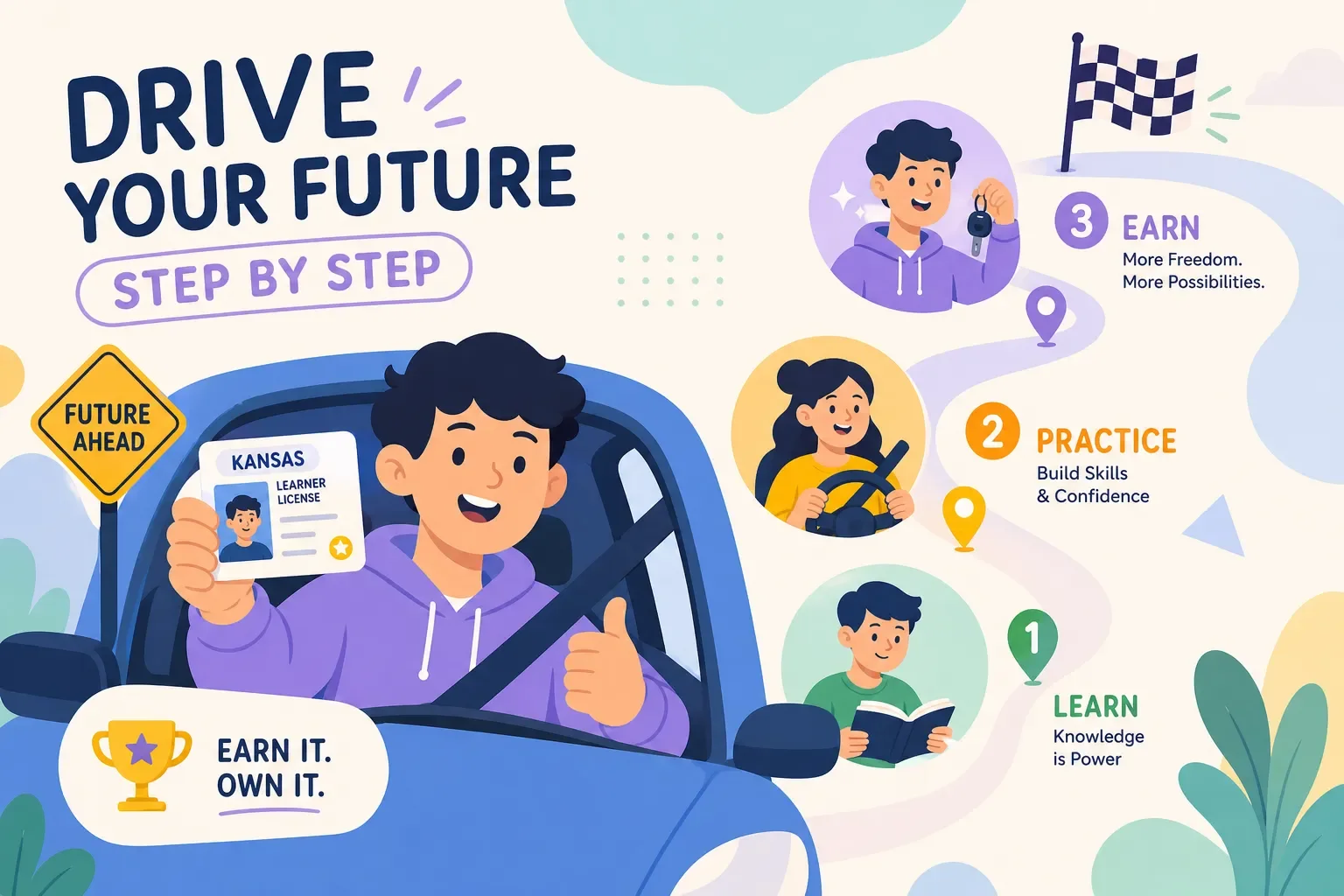
Kansas Graduated License: Step-by-Step Guide for Teens
The graduated license Kansas program runs on a three-stage system, and most families don't realize that until they're already behind. Many assume getting a driver's license is a single event, study, test, done. In reality, each stage of the Kansas graduated driver's license has its own eligibility requirements, holding periods, and documents. Miss one step, and the whole timeline can shift by months. Start at the right age with the right preparation, and the path from zero driving experience to a full license is achievable by 17.
The Kansas graduated driver's licensing system is a structured progression, not a single test day. It starts as early as age 14 with an instruction permit, builds through a restricted license at 15, and reaches full driving privileges at 17. Teens who understand exactly what each stage requires, and parents who help them log the right hours and gather the right documents, move through the process without unexpected delays. Enrolling in a state-approved driver education program early gives teens a meaningful advantage, because the completion document those programs issue is required to advance past Stage 1.
The graduated license Kansas program runs on a three-stage system, and most families don't realize that until they're already behind. Many assume getting a driver's license is a single event, study, test, done In reality, each stage of the Kansas graduated driver's license has its own eligibility requirements, holding periods, and documents. Miss one step, and the whole timeline can shift by months. Start at the right age with the right preparation, and the path from zero driving experience to a full license is achievable by 17.
The Kansas graduated driver's licensing system is a structured progression, not a single test day. It starts as early as age 14 with an instruction permit, builds through a restricted license at 15, and reaches full driving privileges at 17. Teens who understand exactly what each stage requires, and parents who help them log the right hours and gather the right documents, move through the process without unexpected delays. Enrolling in a state-approved driver education program early gives teens a meaningful advantage, because the completion document those programs issue is required to advance past Stage 1.
How the graduated license Kansas system is structured
The three stages at a glance
Kansas teen drivers move through three distinct stages: an instruction permit available at age 14, a restricted license available at age 15, and a full unrestricted Class C license at age 17. Each stage has a mandatory holding period, supervised driving hour requirements, and specific conditions that must all be satisfied before the next stage opens up. A teen cannot test their way past a holding period or skip the documentation requirements.
Why Kansas uses a graduated approach
The graduated structure exists because new drivers face their highest crash risk in the first months behind the wheel, especially at night and with peer passengers in the car. By limiting those scenarios until a teen has more experience, Kansas reduces the conditions most likely to cause accidents. Research on graduated driver licensing programs nationally has documented lower crash rates among teens who complete the full GDL process, and Kansas's restrictions are directly tied to those documented risk patterns.
Graduated license Kansas, Stage 1: Instruction permit at 14
Who qualifies and when to apply
Any Kansas resident who is at least 14 years old can apply for an instruction permit. Teens under 16 cannot apply on their own. A parent or guardian must submit a written application on the teen's behalf, and that parent or guardian must be present with valid photo ID at the licensing office when the application is submitted. Kansas residency is required, meaning the teen needs a birth certificate, U.S. passport, or other approved identity document, proof of a Social Security number, and two separate proofs of a current Kansas residential address. Getting the permit as early as possible matters, because the one-year holding period starts on the issue date, a teen who gets their permit on their 14th birthday reaches the restricted license stage a full year earlier than one who waits until 15.
The vision and written knowledge tests
To receive the instruction permit, teens must pass a vision exam and a written knowledge test. Kansas offers official online knowledge testing through KnowTo Drive, which is the only state-authorized online option. The primary study resource is the Kansas Teen Driver's Handbook, which covers traffic laws, road signs, and right-of-way rules. Teens who complete an approved driver education course may be able to present their completion document at the licensing office in lieu of taking the written exam there, depending on their specific situation.
What the instruction permit allows
The instruction permit allows a teen to drive only with a licensed adult who is at least 21 years old seated in the front passenger seat at all times. No solo driving is permitted during this stage, regardless of how skilled the teen becomes or how short the drive is. This restriction applies for the full one-year holding period, which must be completed before moving to Stage 2.
Stage 2: Earning a restricted license at age 15
The one-year hold and supervised driving requirement
After holding the instruction permit for at least 12 months, teens who are 15 or older can apply for a restricted license, provided they have logged 25 hours of supervised driving with a licensed adult aged 21 or older. Teens who are still under 16 at the time of application also need a parental or guardian affidavit submitted at the licensing office. Both the 12-month holding period and the 25-hour requirement must be satisfied; meeting one but not the other is not enough to move forward.
The driver education requirement and the DE-99
Kansas requires completion of an approved driver training course before a restricted license can be issued. The proof is the DE-99, a state-issued completion document generated by the approved school after the student passes classroom testing at 80% or higher and satisfies the behind-the-wheel evaluation requirements. This form cannot be produced by a parent or created privately. It comes from the school, through the state's driver education instructor portal, and it goes directly to the Kansas DMV.
ICT North Star Driving Academy in Wichita offers exactly this program: 8 hours of classroom instruction covering Kansas traffic laws, road signs, vehicle maintenance, and adverse condition driving, combined with 6 hours of behind-the-wheel training with licensed instructors. Instructors can pick students up at home or school, and lesson scheduling is handled through an online booking tool. Upon completing the program and passing the required evaluations, students receive their DE-99 completion document to bring to the Kansas driver licensing office. (Program details are provided by ICT North Star Driving Academy; confirm current scheduling and availability directly with the school.)
What the restricted license allows and limits
The restricted license is a real, functional credential with firm guardrails. Under this license, 16-year-olds may drive without a supervising adult as long as they stay within the passenger and curfew rules. Teens who are 16 may carry one non-family passenger under 18. Teens who are still under 16 may carry no non-sibling minor passengers at all. A nighttime curfew applies immediately and is covered in detail below. Outside of those boundaries, a supervising adult must be present.
Stage 3: Reaching full driving privileges at 17
The 50-hour supervised driving affidavit
Before a restricted license converts to a full unrestricted license, Kansas requires a total of 50 hours of supervised driving, including at least 10 hours logged at night, all supervised by a licensed adult aged 21 or older. A parent or guardian affidavit documenting those hours must be submitted at the licensing office. If the affidavit is not submitted before the teen's 17th birthday, the restriction period continues automatically until that birthday arrives.
What changes at 17
At 17, the Kansas GDL restrictions lift. Passenger limits tied to the restricted license no longer apply; the nighttime curfew is gone, and the teen moves to a standard Class C driver's license. If the teen has not completed a state-approved Driver's Ed course, a road test is required as part of this licensing step, and teens must supply their own properly equipped vehicle for the driving exam. The test is scheduled through the local Kansas driver licensing office, and it is worth calling ahead to confirm current hours and appointment availability.
Restrictions every teen driver in Kansas must follow
Nighttime curfew rules for restricted license holders
Kansas prohibits restricted license holders from driving between 9 p.m. and 5 a.m. without a supervising adult present. The exceptions are limited to travel directly to and from work, school, or religious activities. Violations can trigger GDL penalties that affect the teen's progress through the system, so it's worth treating these hours as a hard boundary, not a rough guideline.
Passenger limits that catch most families off guard
The passenger rules are stricter than most families expect. Restricted license holders 15-and-under may carry zero non-sibling minor passengers. Those who are 16 may carry one non-family member under 18. These limits apply regardless of how familiar the teen is with the passengers or how short the trip is. Immediate family members are exempt, but Kansas draws that line narrowly, if you are unsure whether a specific person qualifies, check with the Kansas Department of Revenue or consult the Kansas Teen Driver's Handbook for current guidance.
Supervision requirements during the permit stage
During the instruction permit stage, the supervising adult must be at least 21 years old, hold a valid license, and sit in the front passenger seat for every drive. There are no exceptions for short distances, familiar roads, or high-skill situations. The teen cannot operate the vehicle alone until they advance to the restricted license stage.
How driver's ed makes the Kansas GDL process smoother
What completing an approved program actually provides
The DE-99 is the piece most families underestimate until they need it. It cannot be signed by a parent, generated at home, or replaced by an internet-based course certificate. Kansas does not accept online driver education certificates for licensure purposes. The DE-99 comes only from a state-approved driver education school after the student completes both the classroom and behind-the-wheel components and meets the required passing standards.
ICT North Star Driving Academy is built specifically for this process. The curriculum covers Kansas-specific traffic laws, local Wichita road conditions, and the IPDE method (Identify, Predict, Decide, Execute), a structured approach to hazard awareness that new drivers apply from their first behind-the-wheel session forward. Flexible scheduling options mean families are not locked into a single rigid calendar. Getting the DE-99 through a local, state-approved program is what makes every subsequent DMV visit straightforward.
What to bring to the Kansas DMV after completing driver's ed
Arriving at the DMV with the right documents prevents delays and repeat visits. Bring the DE-99 completion document, proof of identity such as a birth certificate or U.S. passport, Social Security documentation, two proofs of current Kansas residency, and a parental affidavit if the teen is under 16. Kansas DMV offices recommend calling ahead or checking current appointment availability before visiting, as hours vary by location.
The clearest path forward starts with knowing where you stand
The graduated license Kansas system is built on three stages that each require specific actions: an instruction permit at 14, a restricted license at 15, and a full unrestricted license at 17. None of those stages can be rushed past a holding period, and each one builds directly on the documentation and supervised hours logged in the previous stage.
Families who move through this process without friction tend to share a few habits: they start early, log supervised hours consistently, and handle the driver education requirement before it becomes a bottleneck. The DE-99 is often the step families put off longest, simply because it requires enrolling in a program rather than showing up to a test. Completing it early removes the single biggest source of delays in the Kansas teen licensing process.
If your teen is ready to start Stage 1, or is already mid-process and needs the DE-99 to advance, a structured, state-approved program is the logical next step. ICT North Star Driving Academy serves the Wichita metro area with exactly that program, built around Kansas requirements from the first classroom hour to the final behind-the-wheel evaluation.
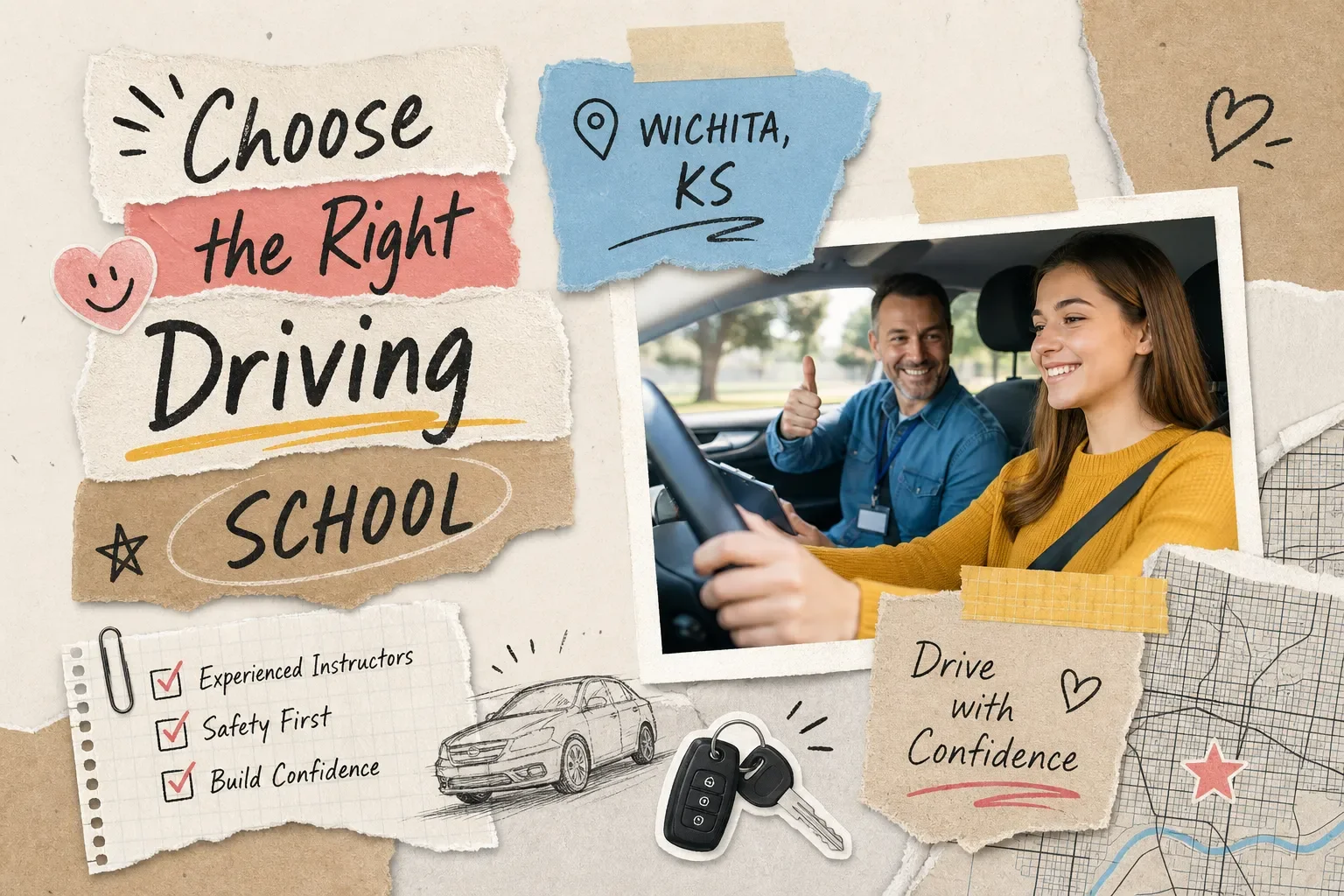
How to Choose the Best Driving School in Wichita, KS
If you're searching for a driving school in Wichita, KS that your family can actually trust, the hardest part isn't finding options, it's telling them apart. Most Wichita parents start the same way: a quick search, a list of local schools, and no real way to distinguish one from another. Every school claims to be state-approved. Most list an address and a phone number. A few have websites with stock photos of smiling teens behind the wheel. But the information that actually matters for making a good decision, curriculum depth, instructor credentials, scheduling flexibility, and whether the school even issues the right documentation for the Kansas DMV, rarely shows up in a Google search result.
If you're searching for a driving school in Wichita, KS that your family can actually trust, the hardest part isn't finding options, it's telling them apart. Most Wichita parents start the same way: a quick search, a list of local schools, and no real way to distinguish one from another. Every school claims to be state-approved. Most list an address and a phone number. A few have websites with stock photos of smiling teens behind the wheel. But the information that actually matters for making a good decision, curriculum depth, instructor credentials, scheduling flexibility, and whether the school even issues the right documentation for the Kansas DMV, rarely shows up in a Google search result.
Not all Kansas-approved driving programs are created equal. Approval from the state sets a floor, not a ceiling. Some schools teach the minimum and move on. Others build their curriculum around real hazard-awareness frameworks, Kansas-specific traffic laws, and practical skills teens will use in their first year of independent driving. This guide walks through exactly what separates driving schools in Wichita, KS, what courses typically cost, what questions to ask, and how to make a confident decision before you pick up the phone.
What Kansas law requires from any approved driver's ed program
The Kansas graduated licensing system at a glance
Kansas uses a graduated driver's licensing (GDL) system for teens, which means licensure happens in stages rather than all at once. A teen can enter the process as early as age 14 by obtaining an instruction permit. From there, they must hold that permit for 12 months, log 50 hours of supervised driving, including at least 10 hours at night, and meet additional milestones before qualifying for an unrestricted license at age 17. Each stage has specific requirements tied to age, time, and documented practice.
Driver's education is required for key restricted-license steps in Kansas and eases DMV requirements along the way (per Kansas DMV/KDOR guidance at drive.ks.gov). Families who skip it often find their teen hitting bureaucratic walls at the DMV that a proper driver's ed certificate would have cleared. Completing a state-approved program also unlocks certain test exemptions that make the overall licensing process smoother.
Minimum classroom and behind-the-wheel hours
The Kansas baseline for an approved private drivers ed course in Wichita, KS and statewide is 8 hours of classroom instruction and 6 hours of behind-the-wheel training, for a total of 14 hours. If a school can't confirm it meets that baseline, stop there.
How the Certificate of Completion works at the DMV
Students who complete a Kansas-approved driver's ed program receive a Certificate of Completion documented on the DE-99 form, which serves as proof of education at the Kansas DMV. This document allows a teen to apply for their instruction permit and move through the licensing stages without having to retake certain knowledge tests. It also enables supervised driving during the course itself, before a permit is even issued. Without a DE-99 from an approved school, a teen faces a longer, harder path to full licensure. Worth noting: Kansas explicitly states that a completion certificate from an online-only program will not be accepted for licensure purposes (per Kansas DMV policy, see KDOR's official licensing guidelines for details).
Driving school Wichita, KS: price and format compared
Typical cost ranges and what drives the price difference
The realistic price range for teen driver education at Wichita driving schools runs from roughly $390 to $675, depending on the package. Standard 14-hour courses (8 classroom hours plus 6 behind-the-wheel) generally fall between $390 and $450. Expanded packages that layer in defensive driving Wichita, KS families often request, or additional academic hours, push costs toward $525 to $675. Price alone doesn't tell you much about quality, but it's a useful anchor for setting budget expectations before you start calling around. A school charging significantly above that range should be able to explain what justifies the difference.
One-day classroom sessions vs. multi-week schedules
The most common format among driving schools in Wichita, KS is a single 8-hour classroom day followed by behind-the-wheel lessons scheduled separately across multiple sessions. Some schools run classroom sessions on a monthly calendar with flexible BTW booking afterward. This structure works well for teens balancing school, sports, or part-time jobs, the intensive classroom day can be knocked out in one Saturday, and the driving lessons spread across available afternoons or weekends. Multi-week formats also give students time to absorb what they learned in class before getting behind the wheel.
What's actually included in behind-the-wheel training
Six hours is the state minimum for behind-the-wheel Wichita lessons, but what happens during those six hours varies significantly between schools. Ask three questions before you enroll: Are lessons one-on-one with a licensed instructor, or does the school use a dual-student format? How far in advance do you have to book? Does the school offer instructor pickup at the student's home or school? It's worth asking about pickup specifically, some Wichita driving schools offer it, while others require families to transport their teen to a facility for every lesson. That logistics difference matters when you're coordinating around a busy schedule.
What a strong driver's ed curriculum actually teaches
Kansas-specific traffic laws, road signs, and local conditions
A curriculum worth your money covers more than generic driving rules. It should address Kansas-specific laws, Wichita-area traffic patterns, road sign recognition, and vehicle maintenance basics that apply to how students will actually drive in this state. Some national chain programs rely on standardized content that may not address local nuance. A teen who learns to drive with Kansas-specific instruction enters their first year on the road already familiar with the legal environment they're operating in.
The IPDE method: why structured hazard awareness matters
The IPDE method (Identify, Predict, Decide, Execute) is the framework serious driver's ed programs use to train hazard awareness rather than just mechanical driving skills. A driver identifies real or potential hazards in the environment and predicts what those hazards may do next. Then the driver decides on the safest response and executes it smoothly. It trains the skills teens need most, early hazard detection, anticipation, and decision-making under pressure, rather than just drilling on parking and turn signals.
ICT North Star Driving Academy builds its entire behind-the-wheel curriculum around IPDE. Students leave the program with a mental framework for decision-making, not just a memorized checklist of rules. Hazard-perception training of this kind is widely recognized in driver education research as a key factor in how new drivers respond when something unexpected happens on the road, exactly when it matters most.
Adverse condition driving and vehicle safety basics
A complete curriculum covers what to do in rain, ice, fog, and reduced visibility. This isn't optional content in Kansas, where weather conditions shift fast and a teen who passed their test in September may be driving on icy streets by December. Schools that skip adverse-condition training leave students underprepared for conditions they'll encounter in their first winter behind the wheel. Before you commit to any Wichita driving school, ask directly whether the curriculum covers hydroplaning, low-visibility driving, and adjusting following distance in wet or icy conditions.
Instructor credentials and scheduling flexibility: what to ask upfront
How to verify a school and its instructors are state-licensed
The Kansas Department of Revenue maintains a list of approved private driver's education schools. Confirming a school appears on that list is the first step, but it's a floor, not a guarantee of quality. Beyond state listing, ask schools directly whether their instructors hold Kansas licensure specifically for driver's ed instruction. Kansas requires instructors to meet specific credential requirements, including approved driver education training and medical certification of fitness. A school that hedges on this question or can't give a straight answer should raise concern.
Choosing a driving school in Wichita, KS, what to ask about scheduling
The way a school handles scheduling before you enroll is a preview of how it operates during the course. Ask these questions directly:
How far out are behind-the-wheel appointments typically booked?
Can lessons be scheduled online, or does everything go through a phone call?
Do instructors pick up and drop off students, or does the family provide transportation to every lesson?
ICT North Star Driving Academy offers an online scheduling tool for behind-the-wheel lessons and instructor pickup at home or school, confirm current availability and details when you reach out. For families managing multiple kids, work schedules, and extracurriculars, that kind of logistical flexibility removes a real barrier. If a school can't answer these questions clearly before you enroll, expect the same vagueness during the course.
Monthly class availability and what that means for enrollment timing
Many driving schools in Wichita, KS run classroom sessions on a monthly schedule. Miss one date, and you're waiting a full month to start. That gap matters when a teen turns 15 and wants to move through the licensing process on schedule. Ask for the next three available class dates before committing to any program. A school that can only tell you about the next available date, not the two after it, is running a tighter operation than most families want to deal with.
How to make your final decision and get started
A simple framework for comparing your shortlist
When you've narrowed down your options to two or three Wichita-area schools, run them through the same set of questions. Is the school on Kansas's approved list? Does the curriculum go beyond the 14-hour minimum with IPDE training, Kansas-specific content, and adverse-condition driving? Are instructors state-licensed for driver's ed instruction? Can behind-the-wheel lessons be booked online, and does the school offer student pickup? What are the next three available class dates? How a school responds tells you more about its operation than any star rating on a review site.
Red flags that signal a school isn't worth your time
Watch for these warning signs during your initial contact with any program:
No clear answer on state licensing or instructor credentials
No online scheduling or BTW booking system
Vague or inconsistent answers about curriculum content
No clear explanation of how the Certificate of Completion is issued and what it covers
Difficulty answering basic questions before you've enrolled
A school that struggles to answer straightforward questions before you hand over a check will not suddenly become easier to work with once your teen is mid-course. The pre-enrollment experience is a reliable signal of how the school actually runs.
Getting enrolled at ICT North Star Driving Academy
ICT North Star Driving Academy is built to check every box this guide covers. The program is designed around Kansas DMV approval requirements and covers Kansas-specific traffic laws, Wichita road conditions, and adverse-weather driving through an IPDE-based curriculum. Instructors hold state licensure, and the school offers both an online scheduling tool for behind-the-wheel lessons and instructor pickup at home or school (confirm current service details at enrollment). Students who complete the program receive a Certificate of Completion on the DE-99 form for submission at the Kansas DMV. Bi-Monthly class sessions keep enrollment options accessible, and the BTW scheduling system means families aren't stuck waiting for a callback to book a lesson.
If you're ready to get your teen started with a driving school in Wichita, KS that takes the curriculum seriously, reach out to ICT North Star Driving Academy and ask about the next available class dates. The sooner the classroom session is locked in, the sooner the behind-the-wheel hours can begin.
The bottom line on choosing the right program
The best driving school in Wichita, KS isn't necessarily the cheapest or the most recognized name. It's the one that's properly licensed, teaches to a real curriculum, and works with your family's schedule rather than against it. Kansas's graduated licensing system makes the quality of a teen's driver education a practical necessity, not just a box to check. A weak program produces a driver who technically holds a certificate but lacks the hazard awareness and decision-making skills to stay safe in that first year on the road.
Use the framework in this guide, ask the right questions, and don't settle for vague answers. ICT North Star Driving Academy is a strong place to start that conversation, call to confirm the next available class date and get your teen's driver education moving with a program built to do this right.
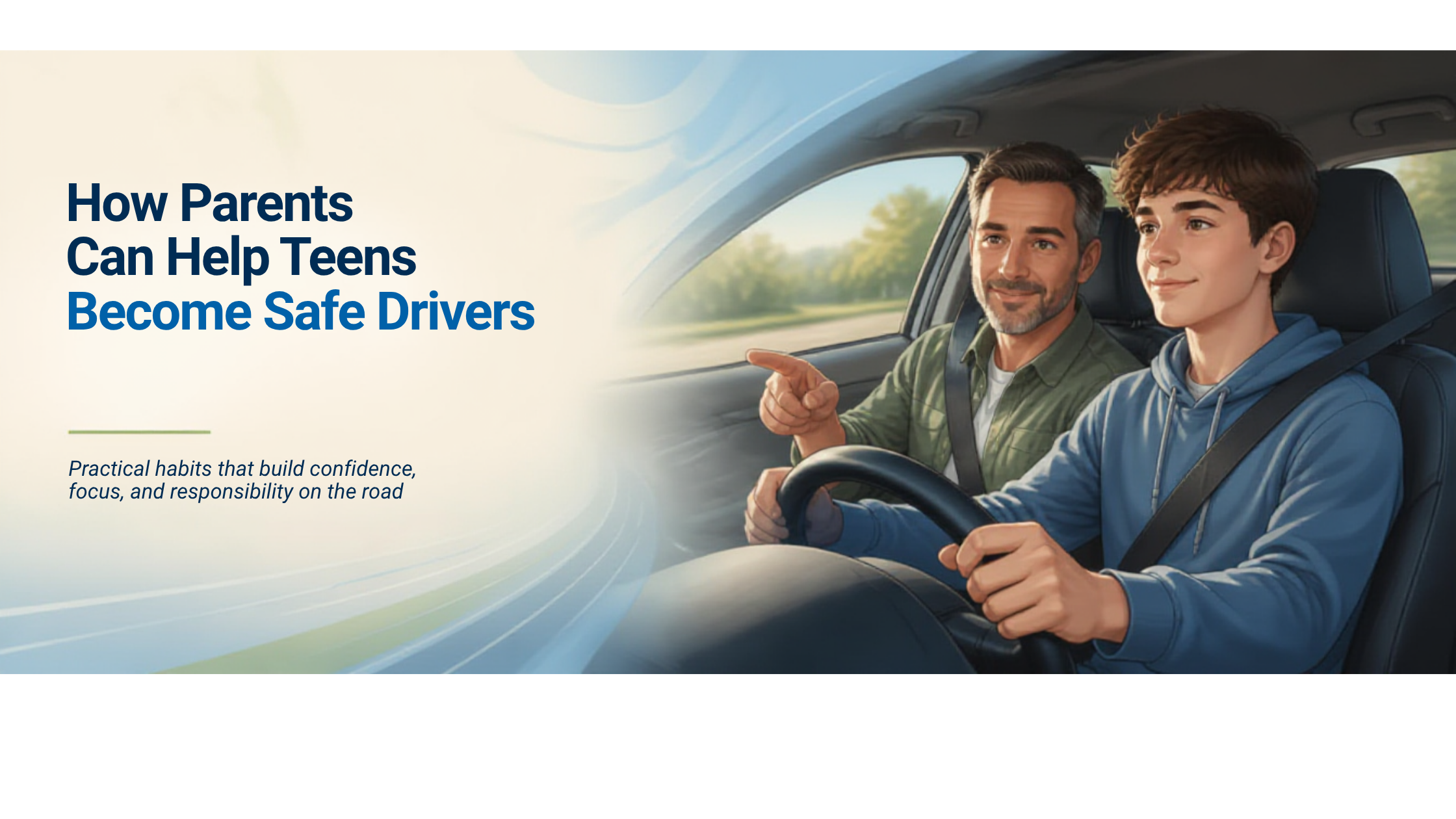
How to Help Your Teen Become a Safe, Confident Driver (Without Constant Stress)
The day your teen gets behind the wheel can feel equal parts exciting and nerve-wracking. You’re not alone—and the good news is that your involvement makes a real difference.
Driving isn’t just a skill; it’s a set of habits built over time. When you model calm, consistent choices and practice together, you help your teen learn how to think, scan, and respond—not just how to “operate the car.”
Start with clear expectations (then practice until it feels normal)
Confidence comes from knowing the rules and repeating them often enough that they become automatic. Before you log more practice hours, take a few minutes to agree on what “safe driving” looks like in your family.
Set a simple standard. Agree on basics like seat belts every trip, speed limits, full stops, and zero risky “showing off.”
Practice regularly—even short drives count. Ten minutes to the store a few times a week builds steadier skills than one long drive once a month.
Talk through higher-risk situations. Make a plan for weather (rain, snow, glare), night driving, passengers, and other distractions before they happen.
Decide how you’ll handle mistakes. Aim for calm corrections: “Next time, start braking earlier,” instead of “What were you thinking?”
Quick reset phrase: “Let’s pull over and take a breather.” It keeps everyone safe and prevents a stressful moment from turning into a fight.
Make phones a shared “put away” rule—for drivers and passengers
One of the most effective safety moves you can make is also one of the simplest: agree that phones stay put away in the car. Not just for your teen as the driver—for everyone.
Driver rule: Phone goes out of reach (glove box, bag, center console) before the car moves.
Passenger rule: Passengers don’t tempt the driver with videos, messages, or “look at this” moments. If something truly needs attention, a passenger can handle it.
Encourage your teen to watch the road, even when you’re the driver: they will pick up a lot just from watching, and maybe they will even have questions about things they observe along the road. Encourage them to watch you drive so that they can learn important routes, road signs and signals, and what to look for while they drive along their route.
Navigation plan: If directions are needed, set the route while parked, use voice guidance, and pull over to make changes.
Family agreement idea: “When the engine is on, phones are away.” Keeping it universal prevents power struggles and reinforces that this is about safety—not control.
Your teen learns most from what you do (even when you don’t realize it)
Your daily driving is your teen’s most frequent lesson. If you want steady habits, show them consistently—especially during “quick” trips when it’s easy to be casual about safety.
Habit to model : What your teen should see
Buckling up : Seat belts on before shifting out of park—every seat, every time.
Avoiding distractions : No texting, no scrolling, and no “just a quick look” at the phone.
Obeying speed limits : Matching the posted speed and adjusting for traffic, rain, darkness, or school zones.
Using turn signals : Signaling early, checking mirrors, and making smooth lane changes.
If you slip (it happens), it’s okay to say it out loud: “I should have signaled earlier—thanks for the reminder.” That teaches accountability and keeps safety a shared value.
Invite your teen to “watch you drive” and listen to your thinking
Here’s a surprisingly helpful strategy: have your teen ask to observe while you drive—and encourage them to pay attention like a student, not a passenger. This builds their judgment before they’re responsible for every decision at once.
Try narrating your choices in a calm, matter-of-fact way (no lectures). Focus on the kinds of decisions teens don’t always notice yet:
Scanning: checking mirrors, looking ahead, and spotting pedestrians or brake lights early.
Safe lane changes: signal → mirror → shoulder check → move when there’s a clear gap.
Parking: choosing a spot, going slowly, and watching for cars backing out.
Handling traffic: leaving space, staying patient, and avoiding sudden moves when others drive unpredictably.
Make it interactive: Ask, “What do you think I’ll do next?” or “Where are the risks right now?” It turns everyday driving into low-pressure training.
Learn the important routes together—so navigation doesn’t steal attention
Early on, your teen’s brain is working hard just to manage steering, speed, spacing, and traffic signs. If they’re also trying to remember turns or hunt for an address, they lose focus fast.
Choose a few high-frequency routes and learn them together until they feel familiar:
School (including pickup/drop-off patterns)
Work
Sports/practices
Common errands (grocery store, pharmacy, a relative’s house)
As you practice, point out “decision spots” (busy intersections, tricky merges, school zones) and do a few runs at different times of day so they experience varied traffic patterns.
Conclusion: steady habits beat perfect lessons
You don’t need to be a professional instructor to help your teen become a safe driver. What matters most is consistent expectations, regular practice, and your example—plus a clear agreement that phones stay put away for everyone in the car.
This week, pick one step: create your family phone rule, practice a key route together, or do a “watch me drive” trip where you narrate your decision-making. Small, repeatable routines are how safe driving habits stick.
Understanding the KansaS Graduated Driver Licensing restrictions & requirements
Guide to Teen Driving Restrictions in Kansas
Learning to drive is an exciting milestone for teenagers, but it also comes with significant responsibilities. In Kansas, the Graduated Driver License (GDL) system is designed to help young drivers gain experience under conditions that minimize risk. This guide will help both parents and teens understand the driving restrictions and requirements set by the Kansas Department of Revenue.
What is the Graduated Driver License (GDL) System?
The GDL system is a three-step program that gradually introduces young drivers to full driving privileges. It aims to reduce risks by allowing teens to gain necessary driving experience before receiving an unrestricted license. The steps include the Instruction Permit, Restricted License, and Full License.
Step 1: Instruction Permit
Eligibility:
Teenagers can apply for an Instruction Permit at age 14.
Requirements:
Must pass a vision test and a written knowledge exam. These can be taken at the DMV or through a state-approved driving school.
Parental or guardian consent is required for applicants under 16.
Restrictions:
Permit holders must be accompanied by a licensed adult who is at least 21 years old every time they operate a vehicle.
Must complete at least 50 hours of supervised driving, including 10 hours at night.
Step 2: Restricted License
Eligibility:
Available to teens who are at least 15 years old.
Must have held an Instruction Permit for at least one year.
Requirements:
Must have completed a state-approved driver education course. Eligibility for the restricted license at 15 is the greatest benefit of taking an approved driver’s ed course.
Provide an affidavit confirming completion of the 50 hours of supervised driving.
Restrictions:
Driving restrictions: To or from work; To or from school on days when school is in session, over the most direct and accessible route between the licensee's residence and school of enrollment for the purposes of school attendance; directly to/from any religious activity held by a religious organization.
Must have a licensed adult in the front seat when driving at any other time.
Only one sibling passenger under 18 is allowed in the vehicle.
Use of wireless communication devices is prohibited except in emergencies.
Step 2.5: Less-Restricted License
Eligibility:
Available to teens who are at least 16 years old.
Must have held an Instruction Permit for at least one year.
Requirements:
Must have completed a state-approved driver education course. Eligibility for the restricted license at 15 is the greatest benefit of taking an approved driver’s ed course.
Provide an affidavit confirming completion of the 50 hours of supervised driving.
Time required to be held: 6 months - after licensee has held the restricted DL for 6 months or until age 17, whichever occurs first, if they have complied with all laws the restrictions will no longer apply
Restrictions:
Driving restrictions: Anywhere from 5am to 9pm; anytime going to or from work; anytime going to or from authorized school activities; directly to or from any religious worship service held by a religious organization; anytime/anywhere with licensed adult - minimum age 21
Must have a licensed adult in the front seat when driving at any other time.
Only one non-sibling passenger under 18 is allowed in the vehicle.
Use of wireless communication devices is prohibited except in emergencies.
Step 3: Full License
Eligibility:
Testing required: Vision. Written and Drive - or certificate of completion from driver education.
Requirements:
if 17, must sign 50 driving hours affidavit. If 18, not required.
Privileges:
Full driving privileges with no restrictions on driving hours or passengers.
Additional Tips for Parents and Teens
Practice Makes Perfect: Encourage consistent practice to help teens become confident and safe drivers.
Lead by Example: Parents should model good driving habits and adhere to traffic laws.
Stay Informed: Keep updated on any changes to driving laws and restrictions.
Safety First: Always emphasize the importance of wearing seat belts and avoiding distractions.
Understanding and following the Kansas GDL rules will help ensure that teen drivers are prepared for the responsibilities of the road. By working together, parents and teens can make the learning process safe and rewarding.
How can you prepare for the driving test?
If the Driving Test at the DMV is creating some anxiety, you may want to consider enrolling in a Driver Education Course offered by a state-approved Driving School. Students who pass both the written and driving tests offered by a state-approved driving school and meet all other state requirements may be able to surpass the tests at the DMV when getting their driver’s license.
Which would you prefer, testing with someone you just met or testing with someone who has helped you develop your skillset along the way? Ultimately, enrolling in Drivers Ed may cost more financially, but may save you time spent and repeat trips to the DMV.
Preparing for the Kansas driving test as a new driver means combining knowledge, practice, and confidence—enrolling in Drivers Ed at ICT North Star Driving Academy gives you all three: our classroom sessions cover Kansas traffic laws, road signs, and the written knowledge test in clear, easy-to-understand lessons that reinforce safe decision-making.
Behind-the-wheel instruction provides supervised, hands-on practice with certified instructors who teach safe habits, maneuvers, and practical strategies for handling nerves and unexpected situations.
Our structured curriculum, personalized feedback, and cool-and-collected instructors help prepare you for your driving test. We will help you identify and correct weaknesses as you progress through your one-on-one driving lessons. You will gain familiarity with local roads and traffic patterns as we navigate the routes you will need to master to travel to-and-from school, work, and beyond. All skills will be reviewed and practiced until mastered, which will reduce surprises and boost readiness for driving independently.
Ultimately, Drivers Ed not only increases your chances of passing the driving test on the first try but also builds the lifelong skills, confidence, and responsible habits needed for safer, more confident driving.
Students who pass the driving test given by their instructor will receive a Certificate of Completion that they can take to the DMV to exchange for their license. Please see the Kansas Department of Revenue’s website for additional information regarding obtaining a Kansas Driver’s License, including what documents to bring to your appointment, Kansas Graduated Drivers Licensing Information, age requirements, and more.
Wichita Area Driving Schools approved by the state of Kansas
Choosing a driving school in the Wichita area requires careful consideration, and one of the most important criteria is whether the school is state-approved; state approval ensures the curriculum meets Kansas Department of Revenue standards, instructors are properly certified, and students receive the required hours of classroom and behind-the-wheel training for licensing and insurance benefits. State-approved programs follow up-to-date safety protocols, offer a structured progression from basic rules to defensive-driving techniques, and maintain records that simplify permit and license processing. Families should verify approval status, review instructor qualifications, confirm vehicle safety and insurance coverage, and compare course content and schedules to ensure the program aligns with their needs. Selecting a state-approved driving school provides legal compliance, proven instructional quality, and greater confidence that new drivers are prepared for real-world road conditions.
Below you will find a list of approved commercial driving schools located in the Wichita Area:
ICT North Star Driving Academy LLC 2311 N. Amidon Ave, Suite B Wichita, KS 67204 316-369-8667 contact@ictnorthstardriving.com
Behind the Wheel Defensive Driving School 800 S. Broadway Avenue, Suite 300 Wichita, KS 67211
KS International Drivers Ed 8651 W. Central Avenue Wichita, KS 67212
Legacy Driving School of Andover, LLC 210 W. Ira Court Andover, KS 67002
Premier Driving School 8651 W. Central Avenue Wichita, KS 67212
Director Peace Driving School LLC 6122 E. Shadybrook Street, Suite 12 Wichita, KS 67208
Wichita Driving School, Inc. 724 N. Country Acres Avenue, Suite 200 Wichita, KS 67212
Shemeza Driving School 404 E. 13th Street N Wichita, KS 67214
Yost Driving School 1735 E 2nd St. N Wichita, KS 67214
Accelerate Your Learning: Enroll at ICT North Star Driving Academy
Accelerate Your Learning: Enroll at ICT North Star Driving Academy
If you are considering enrolling in a driver's education course, look no further than ICT North Star Driving Academy. At just $369, this comprehensive program offers an exceptional blend of theory and practical experience, ensuring you or your teen is well-prepared for the road ahead. Let’s explore the unmatched value you’ll receive when you choose ICT North Star Driving Academy for your driving education needs.
Comprehensive Curriculum
The drivers education program at ICT North Star Driving Academy is built around the renowned AAA: How to Drive curriculum. This 8-hour in-person class provides a thorough foundation in driving theory, covering essential topics such as:
Traffic laws and regulations: Understand the rules of the road to ensure safe and lawful driving.
Vehicle operation: Learn the mechanics of operating a vehicle, from basic controls to advanced maneuvers.
Safety measures: Gain insights into defensive driving techniques, seatbelt use, and managing distractions.
Hazard recognition: Develop the skills needed to identify and respond to potential driving hazards effectively.
This structured curriculum is designed to instill confidence and competence, making sure students are well-equipped to handle real-world driving situations.
Personalized Driving Instruction
Alongside the classroom education, students benefit from 6 hours of private driving instruction with a state-certified driving instructor. This personalized, one-on-one training is invaluable for several reasons:
Tailored Learning Experience: Each session is customized to address individual strengths and weaknesses, allowing students to progress at their own pace.
Hands-On Practice: Students gain practical experience navigating various driving conditions, from quiet residential streets to bustling city roads.
Immediate Feedback: Real-time guidance and feedback help students quickly correct mistakes and reinforce positive driving habits.
Confidence Building: Personalized attention helps reduce anxiety and build the confidence necessary to become a responsible, self-assured driver.
Complete Driving Test with Our Instructors: At the end of your driving lessons, your instructor will test your ability to perform a variety of driving tasks to prove your proficiency behind-the-wheel. Because our course is State-approved, this driving test is performed in place of the driving test given by the DMV. Test with confidence with the support of the driving instructor you have worked closely with throughout your course.
State-Certified Expertise
ICT North Star Driving Academy prides itself on employing only state-certified driving instructors. Our instructors are experienced educators with years of hands-on teaching experience serving students in public education. This ensures that students are learning from qualified professionals who are knowledgeable about the latest driving techniques and regulations. Their expertise provides peace of mind to both students and parents, knowing that safety and education are prioritized.
Exceptional Value
At a competitive price of $369, the program at ICT North Star Driving Academy offers exceptional value. The combination of a robust theoretical framework and hands-on driving practice ensures that students meet state-requirements to earn their license, but are also equipped with the skills necessary for a lifetime of safe driving.
Enrolling in ICT North Star Driving Academy means investing in a comprehensive, high-quality education that lays the groundwork for responsible driving. Whether you are a new driver or looking to refresh your skills, this program offers the guidance and support you need to succeed on the road. Choose ICT North Star Driving Academy and drive your future forward with confidence.
Students who complete all course requirements will receive a Certificate of Completion that can be taken to the DMV to show proof of completion of a State-approved Driver Education course.
Unlocking the Road: Securing a Kansas Driving Permit
Navigating the Path to a Kansas Driving Instructional Permit
For both parents and teens, the journey to obtaining a driving instructional permit in Kansas is an exciting milestone, marking the first step towards driving independence. As a driving instructor, I’m here to guide you through the necessary steps and highlight how enrolling in a driver’s education course at ICT North Star Driving Academy can make this process smoother and more efficient.
Steps to Obtain a Kansas Driving Instructional Permit
Eligibility Requirements: Before applying for a driving instructional permit, ensure that the teen is at least 14 years old. This is the minimum age requirement set by the state of Kansas.
Gather Necessary Documents: Prepare the necessary documentation, including the teen’s proof of identity, proof of Kansas residency, and a Social Security number.
Visit the Kansas DMV: Both the teen and a parent or legal guardian must visit a local Kansas Department of Motor Vehicles (DMV) office. It’s advisable to schedule an appointment ahead of time to reduce wait times.
Complete the Application: At the DMV, complete the application form for the driving instructional permit. The parent or guardian will need to sign this form to give consent if the student is under the age of 16.
Pass the Vision and Written Tests: The teen must pass a vision test and a written knowledge test covering Kansas traffic laws, road signs, and safe driving practices. It’s essential to study the Kansas Driver’s Handbook thoroughly to prepare for these tests. You have 4 tries to pass the written test. If you fail the test on the 4th try, you must wait 6 months to try again.
Pay the Fee: There is a small fee for obtaining the instructional permit, which can be paid at the DMV during the application process.
The Role of Driver’s Education at ICT North Star Driving Academy
Enrolling in a driver’s education course can be an invaluable asset in preparing teens for their instructional permit tests. At ICT North Star Driving Academy, we offer comprehensive courses tailored to equip young drivers with the knowledge and skills they need to succeed.
Structured Learning Environment: Our courses provide a structured learning environment where students can engage in interactive lessons on road safety, traffic laws, and driving techniques. This ensures that they are well-prepared for the written knowledge test.
Experienced Instructors: Our experienced instructors are dedicated to fostering a supportive and encouraging atmosphere for students, helping them build confidence behind the wheel.
Test at our Facility: Students who enroll in Drivers Education at ICT North Star Driving Academy will take a written test to earn an instructional permit at the end of their first day of class. Students will have 4 opportunities to test to earn a passing score. Students who pass the written exam given at ICTNSDA will receive a paper instructional permit that can be taken to the DMV to exchange for their Learner’s Permit and waive the written test at the DMV.
Practical Driving Experience: The academy also offers practical driving sessions, allowing students to gain hands-on experience with a qualified instructor. This practical component is crucial for developing safe driving habits.
By enrolling at ICT North Star Driving Academy, teens not only increase their chances of passing the written exam but also lay a solid foundation for responsible and safe driving in the future. For parents seeking a reliable and effective way to help their teens navigate the path to obtaining a driving instructional permit, our academy is here to support you every step of the way.
In conclusion, while obtaining a Kansas Driving Instructional Permit involves several steps, the process can be significantly streamlined with the right preparation and support. Consider partnering with ICT North Star Driving Academy to ensure a successful and positive start to your teen's driving journey.
Preparing Your Teen for Independent Driving: A Guide for Parents
Hello, parents! As a driver's education instructor at ICT North Star Driving Academy, I understand the excitement and anxiety that come with teaching your teen how to drive. In fact, watching my husband struggle to maintain his composure while helping my oldest stepdaughter behind-the-wheel is what led me to become a certified driving instructor.
The journey to becoming an independent driver is an important milestone in their lives, and your guidance is crucial in shaping them into safe and responsible drivers. Here, I offer some valuable advice on the skills you should practice with your teen to prepare them for commuting to-and-from school and work.
Building a Strong Foundation
Mastering the Basics
Before your teen can confidently navigate the roads alone, they need to master the basics of driving. This includes understanding the vehicle controls, such as the steering wheel, pedals, gear shifts, and dashboard indicators. Spend time practicing these fundamental skills in a safe, low-traffic environment until your teen feels comfortable and confident.
The Rules of the Road
Ensure your teen is well-versed in traffic laws and road signs. Encourage them to study the driver's manual and quiz them on different scenarios they might encounter. Knowledge of right-of-way rules, speed limits, and traffic signals is essential for safe driving. Take every trip in the car as an opportunity to engage in a conversation with your teen by quizzing them on road signs and signals that you encounter on your way to your next destination.
Focus on Defensive Driving
Anticipating Hazards
Teach your teen to anticipate potential hazards and react appropriately. Encourage them to always be aware of their surroundings and watch for pedestrians, cyclists, and other vehicles. Practicing scanning techniques and maintaining a safe following distance can help prevent accidents. Anticipating what could happen is a skill worth practicing.
Handling Emergencies
It's crucial for your teen to know how to handle emergency situations, such as skidding, hydroplaning, or a tire blowout. Practice these scenarios in a controlled environment to build their confidence and ensure they know how to respond calmly and effectively. If they haven’t had much practice driving in adverse weather conditions, keep them off the road or accompany them to work on how to handle things like poor traction in wet/icy conditions or poor visibility.
Navigating Everyday Situations
Commuting to School and Work
Help your teen become familiar with their daily commute by practicing the route together. Discuss potential challenges, such as rush hour traffic or construction zones, and strategize ways to handle them. Encourage your teen to use navigation apps responsibly to stay updated on traffic conditions.
Parking and Maneuvering
Parallel parking, backing into a space, and three-point turns are essential skills for any driver. Spend time practicing these maneuvers in various settings, from busy parking lots to quiet residential streets, to boost your teen's confidence and competence.
Encouraging Independence and Responsibility
Time Management
Teach your teen the importance of planning their trips to allow for unexpected delays. Encourage them to leave early to avoid the stress of rushing, which can lead to unsafe driving habits.
Vehicle Maintenance
Familiarize your teen with basic vehicle maintenance, such as checking tire pressure, oil levels, and understanding dashboard warning lights. Instilling these habits early on can lead to a lifetime of responsible vehicle ownership.
Model Safe Driving Habits
You are your teen’s first role model when it comes to learning safe driving habits. If you often reach for your phone during your commute or forget to put your seatbelt on at times, consider the message this may be sending to your teen. Prioritize safe driving practices like minimizing distractions, wearing your seatbelt, and obeying traffic laws when you have children and teens in the vehicle with you. Consider coming up with a verbal or written agreement with your teen to always wear your seat belt or wait to text until you have parked and secured your vehicle. Make it a policy to let the passenger control the radio or enter your destination in on Maps. Your behavior sends a strong message of what rules should be followed every time you are operating a vehicle.
Integrating Skills in Driver's Education Courses: How we can help
At ICT North Star Driving Academy, we believe in a comprehensive approach to teaching teen drivers. Our courses combine theoretical knowledge with practical experience to ensure a well-rounded education.
Theoretical Instruction
In our classroom sessions, we focus on the foundational concepts of driving. Students engage with interactive materials that cover everything from the basics of vehicle operation to complex traffic laws. These sessions are designed to be engaging and informative, providing students with the necessary knowledge to understand the mechanics and responsibilities of driving. We use a variety of teaching methods, including multimedia presentations, group discussions, games, and quizzes, to reinforce learning and ensure that each student has a firm grasp of the material.
Hands-On Practice
Following the theoretical instruction, students take to the road with our experienced instructors. Our practical driving sessions are carefully planned to align with the lessons taught in the classroom. Students begin in low-traffic areas to build confidence and gradually progress to more challenging driving conditions. This real-world practice is invaluable as it allows students to apply what they've learned in a controlled environment, with the added benefit of receiving immediate feedback from our instructors.
Focus on Defensive Driving
Defensive driving is a core component of our curriculum. We teach students how to anticipate and react to potential hazards through both classroom instruction and on-road practice. By simulating various driving scenarios, such as sudden stops or unexpected obstacles, we help students develop the skills needed to remain calm and make safe decisions in real-life situations.
Building Independence and Responsibility
We emphasize the importance of personal responsibility and time management in our courses. Students are taught to plan their routes, manage their time effectively, and maintain their vehicles. These lessons are reinforced through practical assignments and discussions, helping students develop the habits that will serve them well throughout their driving lives.
By integrating these skills into both theory and practice, ICT North Star Driving Academy equips students with the tools they need to become safe, responsible drivers. Our holistic approach ensures that they are prepared for the challenges of the road and can drive with confidence and independence.
Conclusion
By focusing on these essential skills and fostering a sense of responsibility, you can help your teen become a confident and independent driver. Remember, your support and encouragement play a vital role in shaping their driving habits. Safe travels!
A Teen's Guide to Getting a Kansas Driver's Learner's Permit
Getting your driver's learner's permit is an exciting step towards gaining independence and freedom as a teen. If you live in Kansas, there are several pathways to obtaining your learner's permit, depending on your circumstances. This guide will walk both teens and their parents through the steps involved, including options for those enrolled in driver's education, those who prefer to study and test at the DMV, and recommendations for older teens ready for an unrestricted license.
Pathway 1: Enrolling in Driver's Education
Eligibility Requirements
Be at least 14 years old.
Obtain parental or guardian consent (required if under the age of 16)
Enroll in a Driver's Education Course
Look for a state-approved driver's education program.
Completion of this course is essential as it provides both theoretical knowledge and practical driving experience.
Pros:
Structured learning with professional instructors.
Includes both classroom and practical driving components.
Often integrated into school schedules, making it convenient.
Cons:
May require a fee for enrollment.
Time commitment - approved courses must include at least 8 hours of classroom instruction and 6 hours behind-the-wheel over the course of at least 7 days or more.
Availability may be limited, especially in rural areas.
Additional Steps:
Obtain a Driver's Education Certificate
After successfully completing the course, you will receive a certificate of completion. This document is crucial for the next steps.
Visit the DMV
Bring your driver's education certificate, proof of identity (like a birth certificate), social security verification (W-2 or Social Security Card), and proof of residency (such as a utility bill).
Pass a vision test.
Pay the learner's permit fee.
Receive Your Learner's Permit
With your learner's permit, you can legally drive with a licensed adult over the age of 21 in the car.
Pathway 2: Studying and Testing at the DMV
Eligibility Requirements
Be at least 14 years old.
Obtain parental or guardian consent (required if under the age of 16)
Study for the Written Test
Utilize the Kansas Driver’s Handbook, available online or at your local DMV.
Consider taking online practice tests to familiarize yourself with the format and types of questions.
Pros:
Flexible study schedule at your own pace.
No cost for driver's education courses.
Immediate testing once you feel prepared.
Cons:
No formal instruction, which may make it harder to understand complex rules.
Lacks practical driving experience before obtaining the permit.
Requires self-discipline and motivation to study independently.
If student fails the handbook test 4 times within a 6 month period, student must wait 6 months from the date of the last attempt to test again
Additional Steps:
Visit the DMV
Bring proof of identity, social security, and residency
Sit for the written knowledge test and a vision test.
Pass the Tests
If you pass both the knowledge and vision tests, you'll be eligible to receive your learner's permit.
Pay the required fee to finalize the process.
Practice Driving
With your learner's permit, practice driving under supervision to prepare for the next stage of your driver’s license.
Recommendations for Older Teens
If you are 18 or older, you might be eligible to skip the learner's permit and go straight to getting an unrestricted license, provided you meet certain criteria.
Study for the Tests
Review the Kansas Driver’s Manual thoroughly and take practice tests.
Students who are 18 or older that enroll in Drivers Ed can utilize a temporary instructional permit issued by a state-approved driving instructor to practice road skills behind-the-wheel prior to taking a driving test.
Pros:
Faster pathway to full driving independence.
Avoids the restrictions of a learner's permit.
Suitable for those who need a license quickly due to life circumstances.
Cons:
Requires passing all tests without the gradual learning period of a permit.
May be more challenging without prior driving experience.
Higher stakes with immediate full responsibility on the road.
Pass the Required Tests at the DMV
Complete the written knowledge test, vision test, and driving test.
Provide Necessary Documentation
Bring proof of identity and residency, along with any required forms
Receive Your Unrestricted License
Once all tests are passed and fees are paid, you will be granted an unrestricted license.
Additional Tips for Success
Practice Regularly: Regardless of the path you choose, regular driving practice under supervision is key to becoming a confident and safe driver.
Stay Informed: Laws and requirements can change, so always check the Kansas Department of Revenue website or your local DMV for the latest information.
Be Patient: Learning to drive takes time, patience, and effort. Don't rush the process; ensure you feel comfortable and prepared before progressing to the next step.
Getting a learner's permit is a significant milestone in a teen's life. By understanding the steps and options available, you can navigate the process smoothly and safely. Good luck, and happy driving!
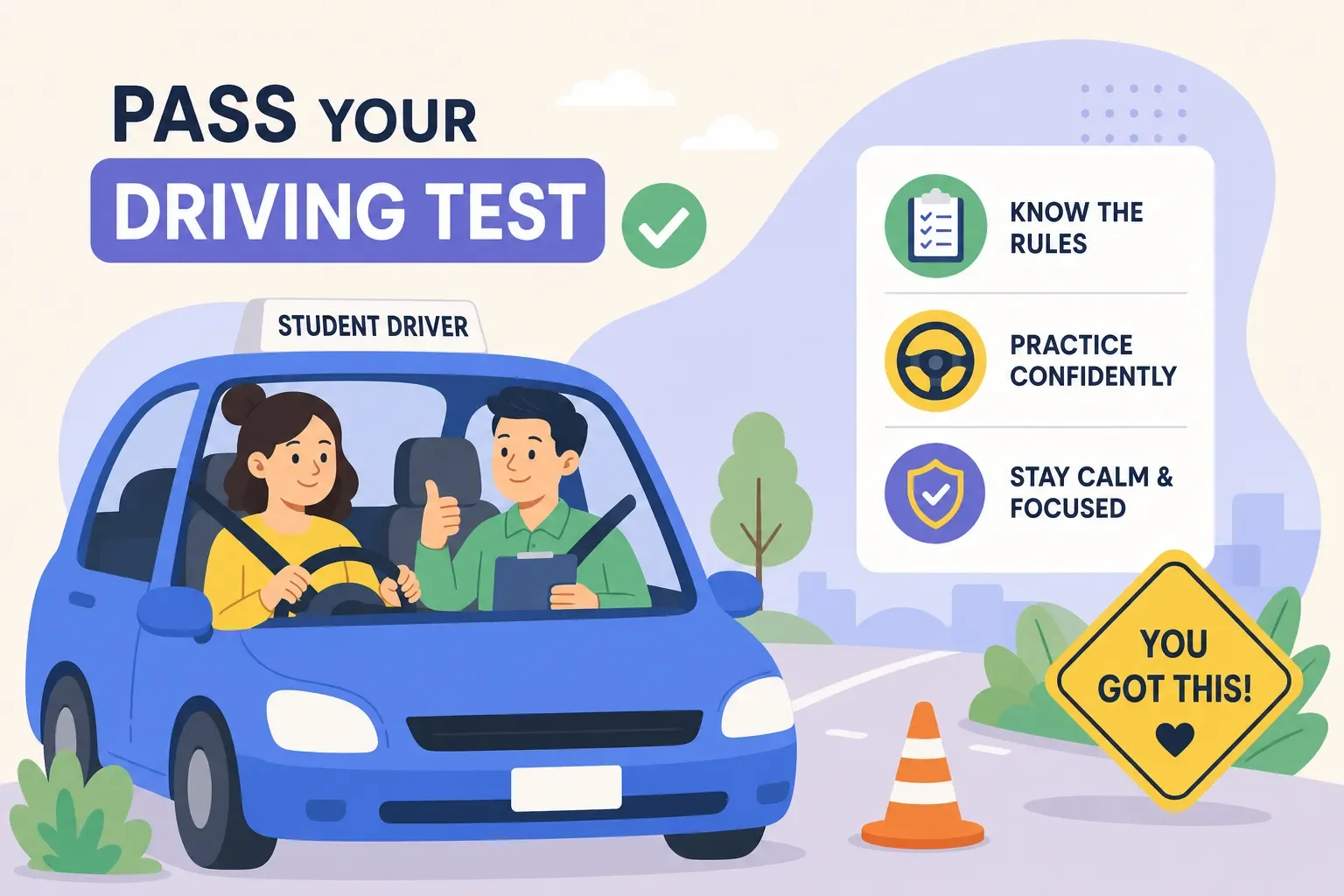
Kansas Driving Test: What You Need to Know to Pass
Many first-time test-takers report assuming the Kansas driving test is a formality. You know what a stop sign looks like. You've ridden in cars your whole life. How hard can it be? Then you sit down at the testing station, and a question about HOV lane occupancy requirements appears on screen. Or one about ice-road braking distances. And suddenly that quiet confidence starts to dissolve.
The truth is the Kansas knowledge test has specific content areas where failure rates are surprisingly high, and winging it with a quick Google search the night before rarely works. That's exactly why structured programs like ICT North Star Driving Academy here in Wichita align their classroom curriculum with Kansas DMV requirements, so students aren't guessing when they sit down for the exam. This guide covers what the test actually includes, where people go wrong, what to bring on test day, where to take the exam, and how to study in a way that makes the material stick.
What the Kansas Driving Test Actually Covers
The test format and passing score
The Kansas knowledge test is a 25-question multiple-choice exam drawn entirely from the Kansas Driving Handbook. To pass, you need at least 20 correct answers, which works out to an 80% passing score. You can take the KS DMV knowledge test in person at a Department of Revenue exam station or online through ks.knowtodrive.com. The online version has a 60-minute time limit, though most people finish well under that.
The six topic areas on the exam
The test pulls from six content categories: road signs (regulatory, warning, guide, school zone, and construction zone), traffic signals, pavement markings, rules of the road, traffic laws, and safe driving practices. One thing worth knowing upfront: while practice tests sometimes offer a standalone Kansas permit practice quiz with 25 road sign questions, the official exam blends all six categories into those 25 questions. There's no fixed number of sign questions, which means you need to know all the categories, not just one or two.
How the knowledge test connects to your road skills
The knowledge test is step one, but it's not isolated from what comes next. Every concept it covers feeds directly into the behind-the-wheel road test: right-of-way, lane discipline, sign recognition, and following distance. Understanding the rules on paper builds the foundation for demonstrating them in a car, which is why students who skip serious test prep tend to struggle later behind the wheel too.
The Topic Areas Most Test-Takers Get Wrong
Road signs, pavement markings, and what the colors actually mean
Based on common Kansas permit test data, over 30% of test-takers miss pavement marking questions, and the most common trap is the yellow center line distinction. A broken yellow line on your side means passing is allowed. A solid yellow line on your side means it's prohibited. That rule sounds simple until you're staring at a question with four similar-looking answer choices. The KS road signs test trips people up too: green means directional information and distance, blue means services like fuel, food, and lodging. Visual familiarity with a sign is not the same as knowing the rule behind it.
Specific numbers the Kansas test loves to ask about
This is where a lot of "I thought I knew it" moments happen. The test pulls very specific figures from the handbook, and guessing usually goes wrong. Here are the numbers most worth locking in:
Signal at least 100 feet before turning in city or residential areas
Maintain a 3-second following distance in normal conditions
Stop no closer than 20 feet from a stopped school bus
Park no closer than 15 feet from a fire hydrant
Speed limits by zone: 20 mph in school and business zones, 30 mph in urban districts
Memorizing these numbers as a group makes them easier to recall under pressure.
Adverse weather and right-of-way scenarios
Stopping distance on ice is 10 times the normal distance, a figure that shows up in test questions and surprises almost everyone the first time they see it. Beyond ice, the Move-Over Law requires you to change lanes or slow down when passing stationary emergency vehicles with flashing lights. Pedestrians have the right-of-way at crosswalks even when you're turning right on green. HOV lanes require at least 2 occupants (the driver plus one passenger). These areas are among the most commonly missed on the Kansas driving test, and they're all learnable with focused study.
Documents, Fees, and What to Bring on Test Day
The ID and document checklist
Arriving without the right paperwork means you don't test that day, so it's worth getting this right in advance. You'll need:
One proof of identity document (a U.S. birth certificate, unexpired passport, or Certificate of Naturalization)
Two proof of residency documents (a utility bill under 2 months old, a bank statement, a lease agreement, or vehicle registration all qualify)
Your Social Security number
If you're under 18, a parent or guardian must be present with their photo ID to sign consent. If you've completed driver's education, bring your Certificate of Completion as well.
Fees to expect
For a learner's permit, the total breaks down as follows: $20 permit fee + $8 photo fee + $3 testing fee, coming to $31. If you're taking the knowledge test separately, that fee is $6.50. For the online version through ks.knowtodrive.com, the first attempt costs $10 and retests are $8.50. Arriving with the right payment method avoids unnecessary delays at the counter.
What happens if you don't pass
A failed test is not the end of the process. You can retake the knowledge test as soon as the next business day, and that's genuinely good news. The part worth taking seriously: if you fail four times within a six-month window, you must wait six months from your last failed attempt before testing again. That waiting period is the real reason to study the high-failure topics first. Burning through retakes on avoidable questions about pavement markings or HOV lanes is exactly the situation good preparation prevents.
Where to Take the Kansas Driving Test and How to Schedule
Finding your nearest exam station
Kansas has exam stations in over 40 counties. Major full-service locations include Wichita, Topeka, Salina, Dodge City, Garden City, Hays, and Junction City, among others. The Wichita station serving Sedgwick County is located at 1873 W 21st N. It's open Tuesday through Friday from 7:00 a.m. to 4:45 p.m. and Saturday from 7:30 a.m. to 11:15 a.m., though testing ends at 4:00 p.m. on weekdays and 10:30 a.m. on Saturdays. Some smaller stations, like Phillipsburg, operate by appointment only, so confirming hours before you make the trip is worth a quick phone call.
How scheduling actually works in 2026
Kansas does not have an online scheduling system for standard driver license exams. You schedule by calling your local exam station directly or visiting in person. The Wichita station can be reached at (316) 838-8115. The KDOR website lets you search by county to find your nearest station's contact number, which makes it easy to call ahead and confirm availability before showing up. CDL skills tests follow a slightly different process and require calling the specific facility Monday through Friday between 8 a.m. and 4 p.m.
How to Study for the Kansas Driving Test and Pass the First Time
Start with the official Kansas Driving Handbook, not just practice tests
Every question on the Kansas exam comes directly from the Kansas Driving Handbook, and you can download it for free as a PDF at ksrevenue.gov/pdf/dlhb.pdf. That Kansas DMV study guide is your primary source, practice tests are useful, but they don't replace reading the handbook first. The handbook gives you the context that makes individual questions make sense. Without it, you're pattern-matching answers rather than actually learning the rules. Read it chapter by chapter, then use Kansas permit practice questions to test yourself on each section before moving on.
Prioritize the high-failure topics with active recall
Re-reading is the least effective way to study for this exam. After each chapter, close the handbook and try to recall the specific numbers and rules you just read. Then run a focused practice quiz on that section. Spend roughly 40 to 50 percent of your total study time on the biggest failure areas: HOV lane rules, pavement markings, and road sign categories. These topics are among the most commonly missed on the Kansas knowledge test, and none of them require more than a focused review session to master.
How structured driver's ed prepares you for exactly this test
There's a meaningful difference between self-studying for a multiple-choice test and going through a structured driver's education program. Programs that align their curriculum to Kansas traffic laws, road signs, and DMV requirements address the exact content categories that appear on the knowledge test, covering the topics where failure rates are highest with instructors available to answer questions and correct misunderstandings before they become wrong answers on test day. ICT North Star Driving Academy is built around that approach, working through Kansas-specific content so students arrive at the exam station prepared rather than hoping for the best.
Behind-the-wheel training reinforces those classroom rules in real driving situations. Right-of-way at intersections, lane changes, signaling distances, these aren't abstract concepts once you've practiced them on actual Wichita roads. For teens 15 and 16, completing a Kansas-approved driver's education program may waive the behind-the-wheel road test requirement, per KDOR policy. Check with KDOR or your program provider to confirm current eligibility requirements.
The Path Forward from Here
The Kansas knowledge test is a 25-question exam with a clear structure, predictable content, and well-documented failure patterns. Knowing the format, studying the right topics in the right order, arriving with the correct documents, and scheduling at the right station removes almost every variable that causes people to fail. None of this is complicated once you know what to focus on.
The knowledge test is also the beginning, not the finish line. Everything you learn for it feeds directly into how you perform behind the wheel, which is why treating the two as connected rather than separate matters. With the right preparation, you can pass the Kansas driving test on your first try. Whether you're working through the handbook and Kansas permit practice questions independently or going through a structured program, the goal is the same: walk into that testing room knowing the material. If you want training built specifically around what Kansas examiners look for, ICT North Star Driving Academy's curriculum is designed to take you from permit test prep through your road test, one clear step at a time.
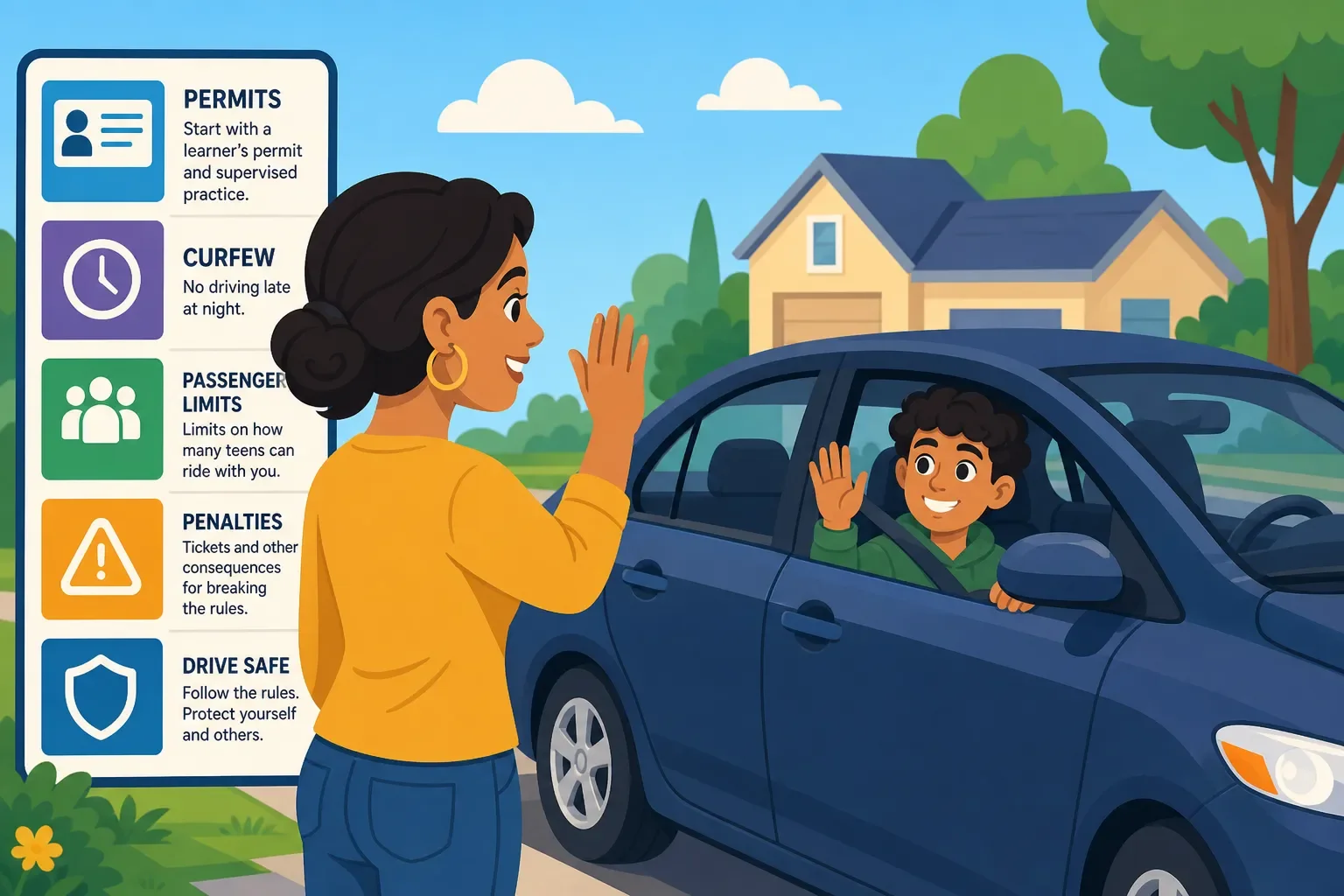
Kansas teen driving laws: What teens and parents must know
Kansas teen driving laws start with a graduated licensing system that has three distinct stages, each with its own rules, hour requirements, and restrictions that most families don't fully understand until something goes wrong. A teen can pass the written test, get their permit, and feel like the hard part is behind them, but that's rarely the case. At ICT North Star Driving Academy, we regularly talk to Wichita-area families who assumed they had the process figured out, only to discover their teen had been driving with the wrong number of passengers or didn't realize the nighttime curfew had already kicked in. Getting these details right from the beginning saves real headaches. This guide covers every stage of the Kansas GDL system: the age thresholds, the exact hour requirements, the curfew and passenger rules, the penalties for violations, and what to bring to the DMV office. Whether your teen just turned 14 or is already holding a permit, the stage-by-stage breakdown below is where to start.
Kansas teen driving laws start with a graduated licensing system that has three distinct stages, each with its own rules, hour requirements, and restrictions that most families don't fully understand until something goes wrong. A teen can pass the written test, get their permit, and feel like the hard part is behind them, but that's rarely the case. At ICT North Star Driving Academy, we regularly talk to Wichita-area families who assumed they had the process figured out, only to discover their teen had been driving with the wrong number of passengers or didn't realize the nighttime curfew had already kicked in. Getting these details right from the beginning saves real headaches. This guide covers every stage of the Kansas GDL system: the age thresholds, the exact hour requirements, the curfew and passenger rules, the penalties for violations, and what to bring to the DMV office. Whether your teen just turned 14 or is already holding a permit, the stage-by-stage breakdown below is where to start.
How the Kansas graduated license system actually works
Kansas doesn't hand a full license to a new driver on day one. The state uses a three-stage Graduated Driver Licensing (GDL) system, built to increase driving privileges gradually as a teen gains experience and demonstrates safe habits. Understanding each stage up front prevents delays and costly mistakes.
Stage 1: The instruction permit (starting at age 14)
A teen can apply for a Kansas instruction permit at age 14. At this stage, a licensed adult who is at least 21 must be in the front passenger seat at all times. The teen cannot use a wireless device while driving, but there are no passenger restrictions. The permit must be held for a full year before advancing, and that clock starts on the issue date.
Stage 2: The restricted license (starting at age 15)
After holding the permit for 12 months, completing an approved driver education program, and logging 25 supervised driving hours, a teen can apply for a restricted license at age 15. Nighttime driving limits and passenger restrictions kick in at this stage. A signed DE-98 parental approval form is also required. This form is completed by a parent or guardian and submitted as part of the restricted license application at the Kansas DOR office.
Stage 3: Moving to an unrestricted license (age 16+)
At 16, after completing 50 total supervised hours (including 10 at night) and holding a restricted license for at least six months, a teen can apply to have restrictions lifted. The nighttime curfew and passenger limits go away at that point. Note that full removal of all restrictions may depend on reaching age 17 and satisfying any remaining holding period requirements under Kansas DOR guidelines, confirm the current conditions at your local DOR office before applying. One rule stays in place until age 18 regardless: the wireless device ban, which prohibits all cell phone or device use while driving except in genuine emergencies.
Supervised driving hours: what Kansas actually requires at each stage
The "50-hour requirement" is the number most families hear first, but Kansas divides that total across two separate licensing stages. Missing that distinction can stall a teen's progress and create confusion at the DMV counter.
The 25-hour and 50-hour requirements explained
To apply for a restricted license, a teen must have completed 25 hours of supervised driving. To upgrade from a restricted license to a full license, the total must reach 50 hours. The supervising adult must be at least 21 years old and hold a valid Class A, B, or C license. Hours driven with anyone who doesn't meet that standard don't count toward the total.
Why 10 of those hours must be at night
Of the 50 total hours, Kansas requires 10 to be completed at night. These are not extra hours on top of the 50, they count within that total. Night driving introduces conditions that daytime practice simply doesn't replicate: reduced visibility, fatigue, and different traffic patterns all factor in. Skipping this requirement is one of the most common reasons teens are turned away at their DMV skills test appointment.
How to document hours properly
Kansas doesn't require a formal log to be submitted, but families must provide a signed DE-IB01 affidavit (the 50-Hour Affidavit) at each licensing stage, confirming the hours were completed. The state also offers a downloadable Kansas Teen Supervised Driving Log to track sessions by date, duration, and conditions. Keeping detailed records protects you if questions come up at the DOR office. For current form links and requirements, check the Kansas Department of Revenue's official driver's licensing page.
Kansas teen driving laws: curfews, passenger limits, and the wireless device ban
Once a teen has their restricted license, the rules on the road are specific and non-negotiable. These aren't suggestions sitting in a pamphlet somewhere, they're statutory restrictions under Kansas GDL law, and violations carry real consequences that can set a teen's driving timeline back by months.
Nighttime curfew rules by age and license stage
Teens with a restricted license (age 16) cannot drive alone between 9:00 p.m. and 5:00 a.m. If a licensed adult who is at least 21 rides in the front seat, the curfew does not apply. Teens on an instruction permit (ages 14 and 15) face a tighter overnight restriction. Kansas DOR guidance identifies specific restricted hours for permit holders, so verify the exact times against current DOR guidance or K.S.A. provisions before your teen drives late. Once a teen turns 17, all nighttime driving limits are lifted entirely.
Passenger restrictions and who counts as exempt
For the first six months of a restricted license, no non-sibling minor passengers are allowed in the vehicle. After six months, one non-immediate family member under 18 is permitted. Siblings and other immediate family members are exempt at all stages, regardless of how many are in the car, though confirm the exact statutory definition of "immediate family" with current Kansas DOR guidance, since that language governs who qualifies. The distinction between "sibling" and "friend from school" matters, and officers know the difference.
The wireless device ban and seatbelt requirement
No driver under 18 can use a cell phone or any wireless device while driving in Kansas, even when stopped at a red light. The only exceptions are reporting illegal activity or calling for emergency help. Separately, all passengers between the ages of 14 and 17 must wear a seatbelt. Skipping the buckle carries a fine (approximately $60 based on current Kansas statute), and it applies to every seat in the vehicle, not just the front. Confirm the exact penalty with the Kansas DOR or the relevant statute, as fine amounts can be updated.
Penalties for breaking GDL restrictions (they're stricter than you think)
Violating any GDL restriction, whether that's the curfew, passenger limit, or wireless device ban, triggers license suspension under K.S.A. 8-291. These aren't warnings with a slap on the wrist. Each offense automatically results in a suspension, and the penalties escalate fast.
The suspension schedule for each violation
A first offense results in a 30-day suspension. A second offense jumps to 90 days. A third offense means a full year without driving privileges. Some violations also carry a misdemeanor charge and a fine in the range of $200, though fines can vary, refer to the current statute or Kansas DOR guidance for exact penalty amounts. For a teen who just got their license, a 90-day suspension is more than frustrating; it can push every subsequent GDL milestone back by months.
Curfew exceptions that are written into state law
Kansas law does carve out exceptions to the 9:00 p.m. to 5:00 a.m. curfew for 16-year-olds. Driving to and from work, school activities, religious services, or farm-related work is permitted during curfew hours. These exceptions apply only when the trip actually matches the stated purpose. A teen driving friends around after midnight doesn't qualify, regardless of what they claim they were doing.
Documents and fees required at the Kansas DMV
Every Kansas driver's license application is handled at a local Kansas Department of Revenue (DOR) office, and appointments are required. Showing up without the right documents means a wasted trip and another scheduling wait. Getting the paperwork right the first time is worth the extra effort.
What to bring for a learner's permit
Applicants need one original proof of identity (such as a certified birth certificate or U.S. passport), two documents showing Kansas residency (utility bills, bank statements, or school transcripts work), and a Social Security card or document showing the full Social Security Number. Teens under 16 must also bring a DE-99 form signed by a parent or guardian, and a parent must be present at the office with their own photo ID, confirm whether the DE-99 is required at the time of application or linked to driver education enrollment by checking the Kansas DOR's current applicant checklist. The total cost for an instruction permit runs approximately $21, covering the permit fee, photo fee, and written test. Verify the current fee breakdown on the Kansas DOR fee schedule before your appointment.
What to bring for a restricted license and what it costs
To apply for a restricted license, teens bring the same identity and residency documents, plus a Certificate of Completion from an approved driver education program and a signed DE-98 parental approval form. The fee is approximately $39 if driver's education has been completed, or $42 without it. Plan to bring your own vehicle for the driving test portion of the application process. Check the Kansas DOR fee schedule for the most current figures before your visit.
Why learning these laws from a certified instructor makes a difference
Kansas teen driving laws cover a lot of ground, and the details matter more than most families realize. A wrong assumption about curfew hours or passenger limits can mean a 30-day suspension for a 16-year-old who just got their license. That's a painful and avoidable way to learn what the rules actually say.
Why piecing it together online creates gaps
State law websites are dense, and information varies across sources. The nuances of the Kansas teen driving laws, like exactly when the passenger restriction changes or which curfew exceptions apply to which license stage, are easy to misread. A teen who fills in the blanks from a general internet search often gets it partially wrong, and partial knowledge doesn't hold up when a police officer is running the plates.
How ICT North Star Driving Academy prepares Wichita-area teens
ICT North Star Driving Academy's 8-hour classroom curriculum is built specifically around Kansas traffic laws, not a recycled national program. State-licensed instructors walk through the GDL requirements, curfew rules, passenger restrictions, the full 50-hour breakdown, and the complete penalty structure so students understand the law before they ever sit behind the wheel. The program also includes 6 hours of behind-the-wheel training. Instructors can pick students up at home or school, making it straightforward to fit around a busy teen's schedule. For families in the Wichita area, that's the difference between guessing and knowing.
The bottom line on Kansas teen driving laws
The Kansas GDL system moves through three clear stages: an instruction permit at 14, a restricted license at 15, and a full license at 16. Along the way, teens must complete 25 supervised hours to reach the restricted stage and 50 total hours, including 10 at night, to reach full licensure. During the restricted stage, the 9:00 p.m. curfew, passenger limits, and wireless device ban are all in effect, with suspension penalties that escalate from 30 days to a full year for repeat violations.
These laws exist because new drivers face real, documented risk. The state structured the GDL system to reduce that risk gradually, and it works when teens and parents take it seriously. The families who run into trouble are usually the ones who assumed they understood the rules without ever sitting down to read them carefully.
If your teen is ready to start driver's education in the Wichita area, ICT North Star Driving Academy offers state-approved instruction built around exactly these Kansas teen driving laws. Enroll today and make sure your teen starts behind the wheel knowing exactly what Kansas law requires at every stage.
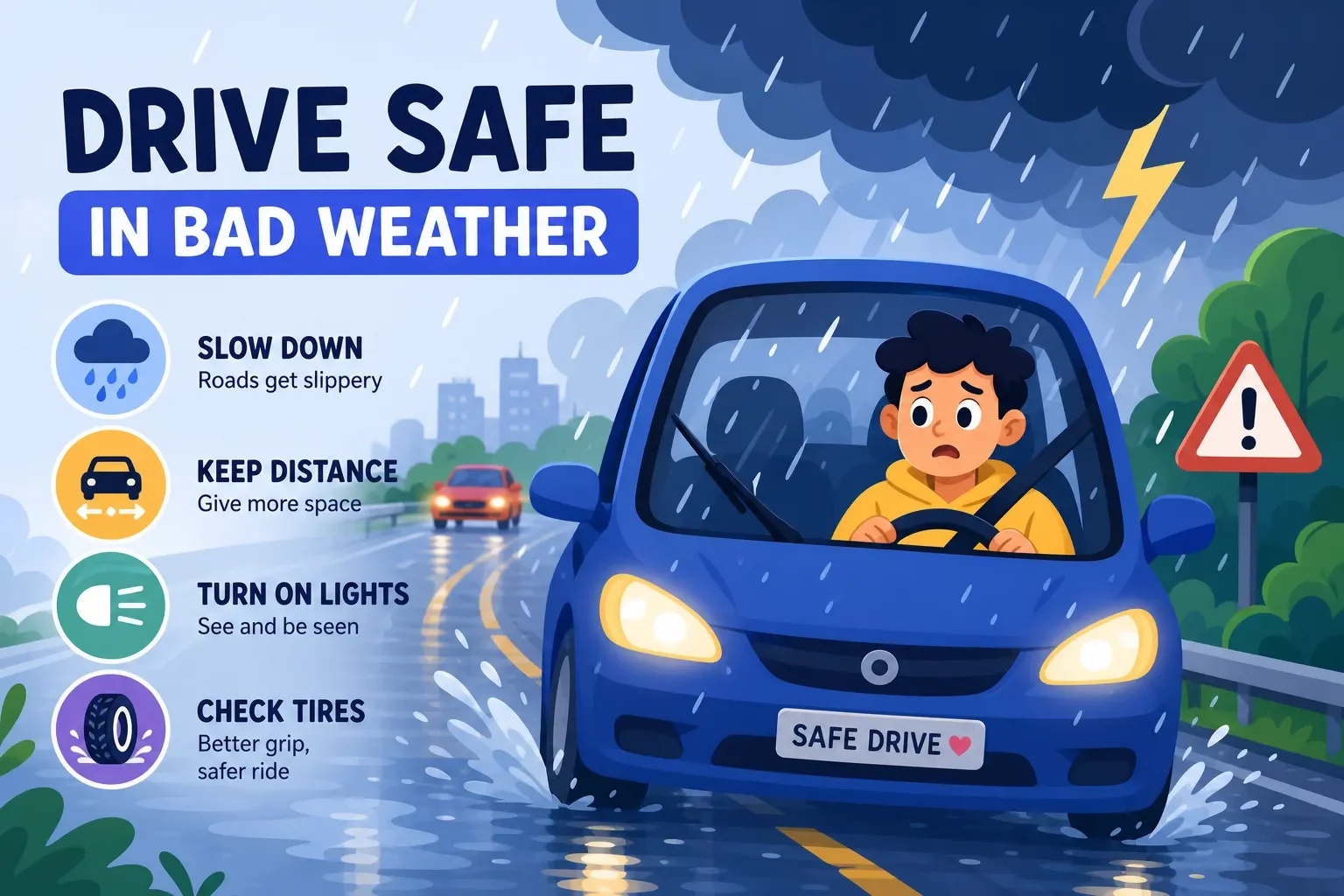
Adverse Weather Driving Tips Every New Driver Needs
Adverse Weather Driving Tips Every New Driver Needs
Most new drivers earn their license after logging practice hours in fair weather. Dry roads, good visibility, mild temps. Then fall arrives, and suddenly the car behaves like a completely different machine. That gap between what teens have practiced and what Kansas roads can throw at them is real, and it matters. These adverse weather driving tips exist because dry-road practice simply doesn't prepare new drivers for rain, snow, ice, or fog, and the difference shows up fast when conditions change.
At ICT North Star Driving Academy, our curriculum covers adverse condition driving in the classroom before students ever sit behind the wheel in rain or snow. Our program addresses the physics, the technique, and the decision-making process so that foundation is already in place when conditions get bad. This article covers those same core principles: rain, snow, ice, fog, and when the right call is to stay home.
Why Bad Weather Catches New Drivers Off Guard
The Experience Gap That Makes Wet Roads Dangerous
New drivers graduate their required practice hours largely in clear, dry conditions. That's not a criticism; it's just math. Wet and icy roads require a different set of instincts, and instincts only develop through exposure and preparation. That surprise of feeling a car start to slide, even at moderate speeds, is exactly what triggers overcorrection in drivers who haven't mentally rehearsed it.
According to NHTSA data, roughly 12% of fatal teen driver crashes involve adverse weather: rain, snow, fog, or ice. That figure might sound low, but it represents crashes where unfamiliar road behavior was a factor. Many of those drivers didn't plan to be in a dangerous situation. They just weren't prepared for how the car would respond when conditions changed.
What Knowing the Theory in Advance Actually Does
Understanding what hydroplaning feels like before it happens changes the response. Instead of panic, there's a process. A mental framework that kicks in when the road surface changes. Teens who know why stopping distance triples on packed snow are less likely to follow too closely in a snowstorm. Classroom instruction can provide that cognitive scaffolding, and while research on traditional driver education and crash reduction is mixed, there's consistent evidence that understanding the physics in advance improves decision-making when it counts. Supervised real-world practice in adverse conditions remains essential alongside any classroom component.
Adverse Weather Driving Tips: Rain, Speed, and Hydroplaning
How Much to Slow Down on Wet Pavement
Wet roads roughly double your stopping distance compared to dry pavement. That single fact should reset every assumption you have about speed and following distance when it rains. The standard 3-second following rule isn't enough. On wet roads, push that to 4 to 5 seconds and reduce your speed by about one-third from your normal dry-road pace. If you'd drive 60 mph on dry pavement, 40 mph is the right target on wet roads.
The first 10 to 15 minutes of rainfall are the most dangerous stretch of any rain event. Road oils rise to the surface before being washed away, creating a slick film that cuts traction significantly. Slow down the most right when the rain starts, not after you've already been driving in it for a while.
Four Habits That Prevent Hydroplaning
Hydroplaning happens when your tires ride on a film of water instead of contacting the road surface. Four habits reduce that risk: reduce your speed, keep tires properly inflated with adequate tread depth, turn off cruise control, and steer around standing water when possible. On tread depth, use the penny test, insert a penny into a tread groove with Lincoln's head facing down. If you can see the top of his head, the tires need replacing. On cruise control: in wet conditions, the system can accelerate into a hydroplane event rather than letting the car slow naturally, which is how a routine rainstorm becomes an emergency. Turn it off any time the road is wet.
Recovering from a Hydroplane Without Making It Worse
When a hydroplane starts, lift off the accelerator immediately. Do not brake. Steer gently in the direction the car is moving, keep the wheel steady, and hold position until you feel the tires reconnect with the road. Most hydroplane events last one to two seconds. The event itself isn't usually the problem. The panic response is. Overcorrection and hard braking are what turn a brief loss of traction into a spin.
Snow and Ice: Where Everything Changes
Snow and ice get the most attention in winter driving, and for good reason. The margin for error compresses dramatically, and the techniques that work on wet pavement aren't enough.
The One-Third, One-Half, and Crawl Rule
This is the CDL-standard guideline used across all 50 states, and it applies to every driver, not just commercial operators. On wet roads, reduce speed by one-third. On packed snow, reduce by at least half. On ice, reduce to a crawl or stop driving entirely. Using 60 mph as a dry-road baseline: that's 40 mph on wet, 30 mph or less on packed snow, and 5 mph or near-stop on ice. These aren't soft suggestions. They reflect the actual physics of traction loss.
Stopping Distance on Snow and Black Ice
Per AAA research, at 60 mph on dry pavement, stopping takes roughly 140 feet. On packed snow, that stretches to 300 to 450 feet. On black ice, stopping distance can exceed 1,400 feet, more than four football fields. Those numbers translate directly into following distance: 5 to 6 seconds on packed snow, 8 to 10 seconds on icy roads.
Black ice is one of the most dangerous surface conditions on Kansas roads because it's nearly invisible. It appears as a dark, glossy patch that looks like wet pavement. The road surface seems unnaturally smooth, and vehicles ahead won't kick up water spray despite the road looking wet. In Wichita, black ice forms first on bridges and overpasses, shaded stretches under tree cover or underpasses, and low-lying dips where moisture settles. The Arkansas River corridor and surrounding roads can also develop thin ice patches when temperatures drop after rain. Early morning and overnight hours carry the highest risk.
Skid Recovery: The Technique That Works
For a rear-wheel skid, steer gently into the direction of the slide. For any skid, the universal rule holds: no sudden braking, no jerking the wheel. Ease off the gas, steer calmly, and let traction return before making any further correction. If you drive a manual transmission, disengage the clutch during a skid to prevent engine drag from worsening the slide. The goal is to let the car settle, not to fight it.
Fog and Wind: The Hazards New Drivers Dismiss
Visibility Thresholds: Slow Down Versus Pull Over
When visibility drops below 0.1 miles (about 160 meters), staying in a travel lane becomes genuinely dangerous. At that point, pull off to a parking lot, rest area, or side street. Turn on your hazard lights. The shoulder is not a safe stop, it puts you in the path of drivers who may drift without seeing you.
The specific mistake to avoid in heavy fog is slowing dramatically in a travel lane without pulling off. A driver who can't see you won't have time to react to your brake lights. Either maintain a safe speed and stay aware, or exit the road entirely.
Driving in High Wind Safely
Wind is unpredictable in a way that rain and snow aren't. A gust can affect vehicle stability without warning, especially on open highways, overpasses, and when passing large trucks. The real hazard isn't constant wind, it's the sudden hit after a lull. Grip the wheel firmly, reduce speed, and leave extra lateral space from other vehicles. High-profile vehicles like SUVs and trucks are more vulnerable to crosswinds than lower-clearance sedans, so if you're driving something tall, treat wind as a serious condition, not background noise.
When Not to Drive: Making the Call Before You're Already on the Road
The Conditions That Mean Skip the Trip
If visibility is below 0.1 miles, roads are icy or closed, or an active weather system is moving through, the trip isn't worth it unless it's a genuine emergency. That's not a vague suggestion; it's a threshold. The common mental trap for new drivers is feeling obligated to go because they planned to, or not wanting to seem overstated about conditions. Experienced drivers make the stay-home call regularly. It's a skill, not a weakness.
Kansas teens on a learner's permit can't drive alone in any condition, including adverse weather. Teens with a restricted license are curfewed until 9 p.m., which intersects directly with evening winter storms. Know your restrictions and plan around them.
How to Pull Over Safely If Conditions Deteriorate While You're Driving
Signal early, slow gradually, and exit to a parking lot or side street rather than the shoulder when possible. Turn hazard lights on once stopped. Stay in the vehicle unless there's a specific reason to exit. If you're stranded in snow, check that the exhaust pipe isn't blocked before running the engine for heat, and crack a window slightly to prevent carbon monoxide buildup inside the cabin.
Building Your Car Emergency Kit Before Conditions Hit
What Every Driver Needs Year-Round
A portable lithium-ion jump starter is more reliable in cold weather than traditional jumper cables and works without a second vehicle. Add a first aid kit, flashlight with extra batteries, reflective triangles or flares, non-perishable snacks, bottled water, and a portable phone charger. These items aren't winter-specific, heavy rain and high wind can strand drivers in any season.
Winter-Specific Additions for Kansas Roads
Layer in the following for cold-weather driving:
Ice scraper and snow brush (long-handled)
Collapsible shovel for clearing snow from around the exhaust pipe if stranded
Traction aids: cat litter or sand work well for getting unstuck on ice
Warm blankets or an emergency Mylar sleeping bag
Gloves, warm socks, and a hat
Hand-crank or battery-powered weather radio for when cell networks are overloaded during severe storms
A portable power station is worth adding if the budget allows. In 2026, compact 1kWh units have become more affordable and can run an electric blanket or charge devices without keeping the vehicle running. That's a meaningful upgrade over sitting in a cold car waiting for help.
Prepare Before the Conditions Arrive
Adverse weather doesn't have to be frightening if you have a framework before you need one. The habits that matter most come down to one consistent thread: slow down more than feels natural, build in more space than you think you need, and make the call to stop before the road forces it on you. Those aren't complicated concepts, but they have to be internalized before things go sideways.
That's the reason well-designed driver's education programs include condition-specific training in the classroom alongside behind-the-wheel practice. Teens who understand the physics of stopping distance and the mechanics of a hydroplane before they encounter them for the first time tend to respond better when conditions change, though supervised practice in actual adverse conditions remains the most critical piece. Reviewing these adverse weather driving tips periodically helps reinforce that response so it becomes more automatic when roads get slick.
If you're a Kansas teen or the parent of one, the time to work through this isn't when a winter storm warning is already posted. Think through your vehicle kit, your restrictions, and your go/no-go thresholds now. At ICT North Star Driving Academy, that kind of preparation is built into how we teach, because knowing what to do before the weather changes is exactly what separates drivers who handle bad conditions from those who get caught by them.
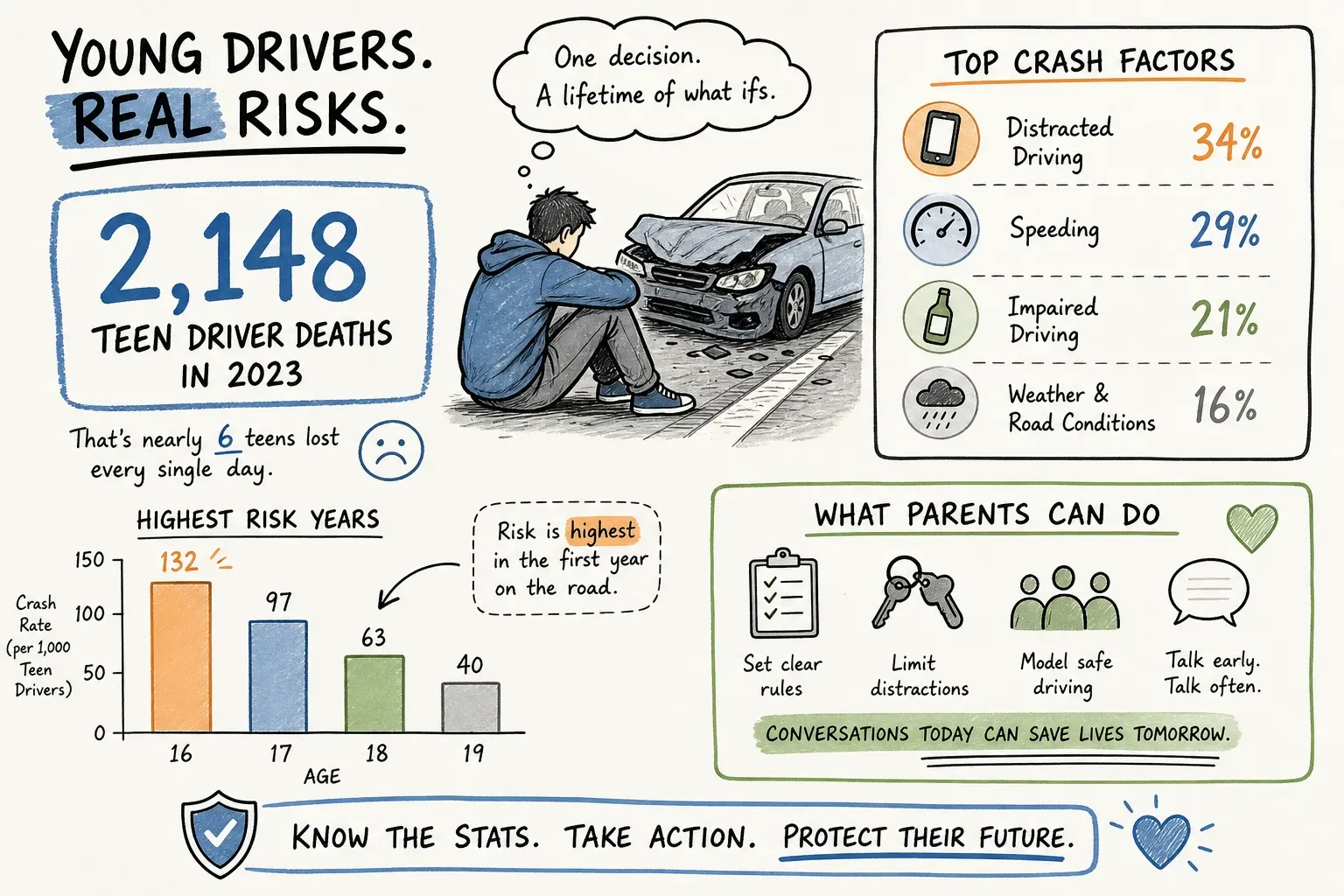
Teen Driver Accident Statistics 2026: What the Data Shows
Teen driver accident statistics reveal a stubborn, documented problem: more than 2,100 young drivers are in fatal crashes on U.S. roads every year. The reasons are documented, the data are available, and yet the same crash patterns repeat year after year. What's less common is a clear-eyed reading of what the numbers actually say and what to do about them.
This article breaks down the most current teen driver crash data available, explains what's driving these crashes, and gives parents and teens a straight look at the real risks. Programs built around hazard recognition, like the curriculum at ICT North Star Driving Academy in Wichita, exist precisely because the data points to a specific, fixable gap in how we train new drivers. Start with the numbers.
Teen Driver Accident Statistics 2026: What the Data Shows
Teen driver accident statistics reveal a stubborn, documented problem: more than 2,100 young drivers die on U.S. roads every year. The reasons are documented, the data are available, and yet the same crash patterns repeat year after year. What's less common is a clear-eyed reading of what the numbers actually say and what to do about them.
This article breaks down the most current teen driver crash data available, explains what's driving these crashes, and gives parents and teens a straight look at the real risks. Programs built around hazard recognition, like the curriculum at ICT North Star Driving Academy in Wichita, exist precisely because the data points to a specific, fixable gap in how we train new drivers. Start with the numbers.
Teen driver accident statistics: fatalities and injuries each year
2023 fatality and injury numbers from NHTSA
The confirmed 2023 numbers from NHTSA: 2,148 young drivers between ages 15 and 20 were killed in traffic crashes, and 180,209 were injured. The fatality count rose 5% from 2022's 2,037 deaths, while injuries declined slightly year over year. Both numbers represent drivers only.
The bigger number most people miss
The driver fatality figure tells part of the story. The full picture is 5,588, the total number of people killed in crashes involving a teen driver in 2023, counting passengers, pedestrians, and occupants of other vehicles. That's a 4.2% increase from 5,361 in 2022. Teen driver crashes are not just a teen problem. Everyone on the road shares the consequences.
Where 2024 data stands right now
Finalized NHTSA data for young drivers in 2024 hasn't been released yet. IIHS estimates, which use an ages 13 to 19 bracket, put 2024 teen deaths at 2,106, a slight decline from 2,170 in that same age range in 2023. NHTSA typically takes 12 to 18 months to publish finalized annual crash reports, which is why 2025 data simply doesn't exist yet. The 2023 NHTSA figures remain the most complete picture available.
Why teen crash rates run so much higher than adult rates
Teen driver accident statistics by age: 16 through 19
The per-100,000-licensed-driver fatal crash involvement rates from 2022 NHTSA Traffic Safety Facts data are striking. At age 16, the rate is 193 per 100,000 licensed drivers. At 17, it's 307. At 18, it climbs to 426. At 19, it reaches 505. The rate increases with age through the teen years, in part because older teens log more miles driven. Still, all four groups significantly outpace adult rates.
The per-mile comparison tells the clearest story
Controlling for exposure changes the picture considerably. Teen drivers between 16 and 19 crash at nearly four times the rate of drivers 20 and older per mile driven. Drivers aged 16 and 17 specifically have a fatal crash rate about three times higher per mile than adults, and crash rates for 16- and 17-year-olds are almost double those for 18- and 19-year-olds per mile. The risk is concentrated at the youngest end of the spectrum.
Inexperience is the core variable, not age alone
The hazard recognition deficit is what actually drives these numbers. New drivers haven't built the mental library needed to automatically scan intersections, read traffic patterns, or anticipate what the car ahead is about to do. Research consistently identifies inexperience and hazard-recognition deficits as the central drivers of young driver risk, though attitudes and risk tolerance also play a role. It's a skills gap that only structured practice and accumulated miles can close.
The specific factors showing up in fatal teen crash data
Nighttime driving: the single biggest environmental risk
According to CDC data, 44% of teen motor vehicle crash deaths among 13- to 19-year-olds occur between 9 pm and 6 am. Fatal crash rates per mile are roughly four times higher at night for teens than during daylight. Reduced visibility, fatigue, and a higher concentration of impaired drivers on the road all compound the risk at exactly the moment a new driver is least equipped to handle it.
Speeding: present in roughly one-third of fatal crashes
Speeding is a factor in 33% of fatal crashes involving teen drivers ages 15 to 18, according to NHTSA data. Male teens push that number higher: 35% of male drivers aged 15 to 20 in fatal crashes were speeding. Speeding compresses reaction time and multiplies crash severity, which is why this single factor shows up so consistently across years and data sources.
Distraction: the most underreported young driver risk factor
Teen distracted driving statistics tell only part of the story. NHTSA reporting shows 11% of drivers under 20 in fatal crashes were reported as distracted, the highest proportion of any age group. "Reported" is the key word, because distraction is notoriously difficult to confirm after the fact. Alcohol involvement ranges from 22% to 32% depending on the BAC threshold used.
Passengers: a separate and significant crash multiplier
Passenger presence is its own risk category. NHTSA and CDC data indicate that just over half of teen passenger deaths happen in crashes involving teen drivers, and adding teen passengers to the vehicle increases crash risk significantly. This is why most GDL laws include passenger restrictions, the numbers make a compelling case for them.
State-by-state teen driver accident statistics: the risk gap is enormous
Highest-risk states for teen driver fatalities
Kentucky leads the country with 138.36 teen driver deaths per 100,000 licensed young drivers in 2023, which is 63% above the national average. New Mexico (79.02), Mississippi (74.33), Arizona (74.05), and Tennessee (67.48) round out the top five. Southern states dominate this list. Florida has the highest raw death count at 158, driven by population size rather than rate.
Lowest-risk states and what they're doing differently
New Hampshire sits at 15.61 per 100,000, nearly nine times lower than Kentucky. Minnesota (16.21), Hawaii (16.89), and New Jersey (18.63) follow. These states consistently maintain stronger graduated driver licensing laws, denser urban road networks with lower average speeds, and higher licensing age requirements. The gap between states is not random.
What drives the difference between states
Rural road infrastructure, average driving speeds, GDL law strength, and enforcement consistency explain most of the variance. States with comprehensive GDL provisions, including nighttime restrictions, passenger limits, and minimum permit periods, consistently show lower teen crash data. The spread between the safest and most dangerous states reflects concrete policy decisions that are within each state's power to change.
What the research says actually reduces teen crash risk
Graduated driver licensing statistics: laws that cut fatalities significantly
Comprehensive GDL programs reduce fatal crash rates for 16-year-old drivers by 20% to 41%, depending on how many provisions the law includes. Overall crash rates drop 16% to 22% for the same age group. States with six or seven GDL provisions in place see the largest reductions, and a learner's permit period of at least six months is independently associated with lower fatal crash rates, according to NHTSA summaries and peer-reviewed meta-analyses. Since widespread GDL adoption began in the mid-1990s, teen crash deaths have declined 48% nationally.
Structured driver education addresses the hazard recognition gap directly
GDL laws matter, but laws don't teach a teenager to scan an intersection. That's where structured driver education fills the gap the statistics reveal. Programs using the IPDE method (Identify, Predict, Decide, Execute) train new drivers to systematically process the road environment before a hazard becomes a threat. At ICT North Star Driving Academy in Wichita, the curriculum is built around this hazard-recognition framework, pairing classroom instruction with behind-the-wheel time under licensed instructors. That combination directly targets the young driver risk factors that show up in teen driver accident statistics year after year.
What parents can do starting now
Set and enforce nighttime driving restrictions before the law requires you to. Limit teen passengers for the first six to twelve months of independent driving. During supervised practice sessions, narrate your own hazard scanning out loud so your teen can hear what reading the road actually looks like. Review your specific state's GDL requirements closely, because the variation between states is significant enough that the details matter.
The bottom line
Teen driver accident statistics have improved substantially over the past three decades. The numbers are serious. They are also improving. The research is clear on what drives that progress: strong GDL laws, meaningful supervised practice, and driver education that builds hazard recognition from day one. The 48% decline in teen crash deaths since the mid-1990s didn't happen by accident.
The gap between the safest and most dangerous states proves that preparation and policy make a real difference. For families in Kansas and across the country, the most actionable step is pairing GDL compliance with a structured program that teaches teens to read the road, not just pass a test. The data already shows what works. Acting on it is the only remaining variable.
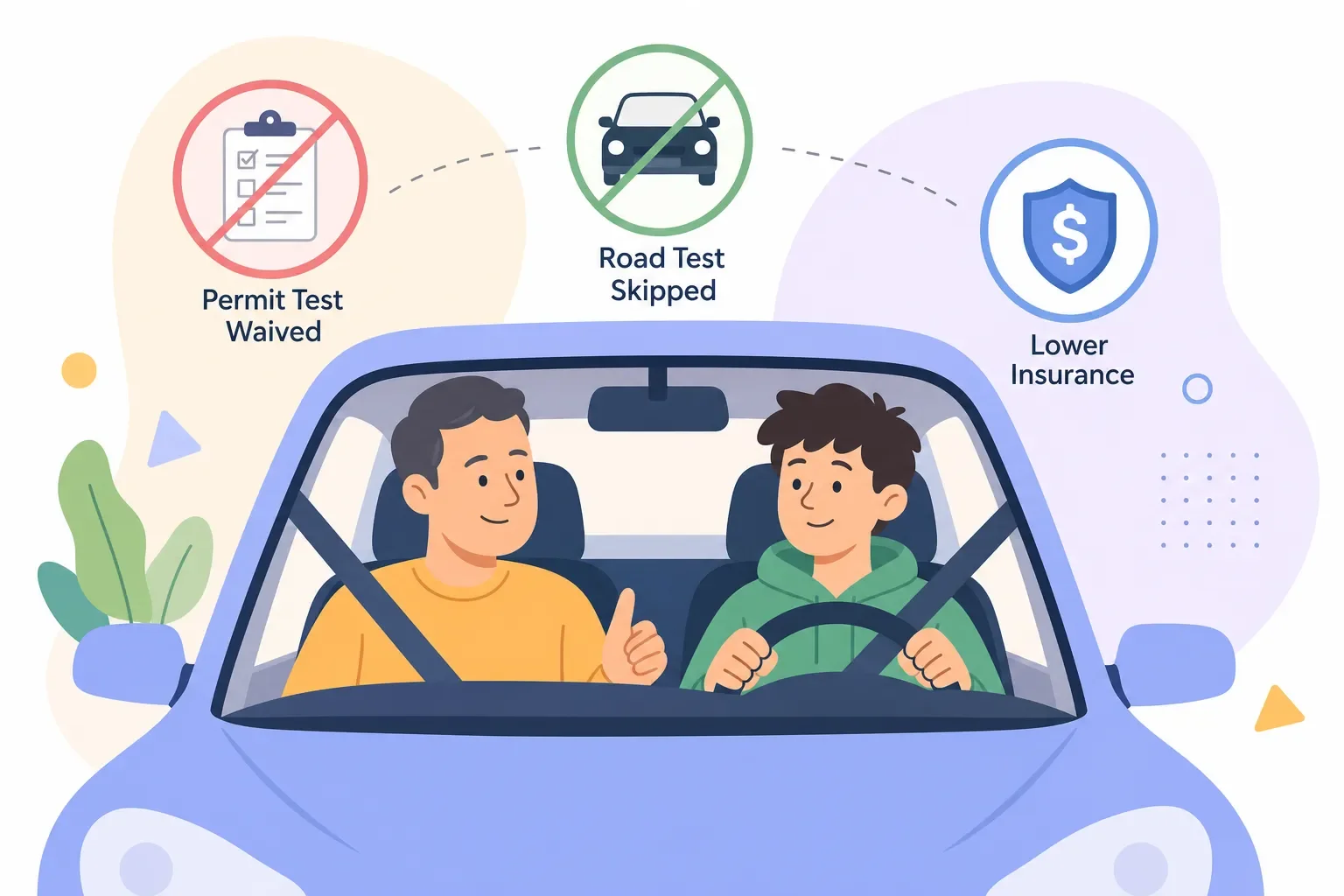
What a Kansas Driver's Ed Certificate Does for You
What does a certificate of completion from drivers ed do for me in Kansas? It certainly shouldn't be filed away - this document is only valid for a limited time after completing a Driver's Ed program.
The Kansas DE-99 Certificate of Completion is a functional document with specific legal weight. It changes what you're required to do at the DMV, which tests you have to take, and what your family pays for car insurance every month, provided the certificate comes from a KSDE-approved, in-person program. Every student who completes ICT North Star Driving Academy's program in Wichita and passes the comprehensive driving exam walks out with this certificate. Knowing how to use it is what makes the next steps with the Kansas DMV straightforward instead of confusing.
Here's a practical breakdown of every concrete benefit this drivers ed certificate in Kansas unlocks, what documents to bring, and what the fine print actually says.
What does a certificate of completion from drivers ed do for me in Kansas? It certainly shouldn't be filed away - this document is only valid for a limited time after completing a Driver's Ed program.
The Kansas DE-99 Certificate of Completion is a functional document with specific legal weight. It changes what you're required to do at the DMV, which tests you have to take, and what your family pays for car insurance every month, provided the certificate comes from a KSDE-approved, in-person program. Every student who completes ICT North Star Driving Academy's program in Wichita and passes the comprehensive driving exam walks out with this certificate. Knowing how to use it is what makes the next steps with the Kansas DMV straightforward instead of confusing.
Here's a practical breakdown of every concrete benefit this drivers ed certificate in Kansas unlocks, what documents to bring, and what the fine print actually says.
What does a Certificate of Completion from Driver's Ed do for me in Kansas?
The short answer: a Certificate of Completion from a State-approved Driving School waives the written knowledge test at the permit window, typically waives the road test when you apply for your license, and may qualify your family for an insurance discount. None of those benefits are automatic, you have to know what you're holding and how to use it. The sections below break down each benefit in detail.
What the DE-99 Certificate of Completion actually is
The difference between the Instructional Permit and Certificate of Completion
Kansas uses two distinct forms related to the DE-99, and confusing them at the DMV counter wastes everyone's time. The Instructional Permit is issued during the course, after the student passes the written exam given after 8 hours of classroom instruction. It lets a student apply for an instruction permit while still actively enrolled in training. The Certificate of Completion is issued only after the student finishes and passes the full program, including the driving exam. The Certificate of Completion is what carries real weight at the DMV for licensing purposes and test waivers. Before you walk into any DMV office, confirm which one you're holding.
How your driving school submits completion to the state
Your driving school files your completion electronically with the Kansas Department of Revenue system. The DMV can pull up your record directly, which means you don't need to chase down separate verification paperwork beyond presenting your certificate. This electronic submission only applies to KSDE-approved, in-person programs, the dedicated section below explains why online course certificates won't satisfy Kansas DMV requirements.
How a Drivers Ed certificate in Kansas waives your written knowledge test
What the test waiver means at the permit window
The first concrete benefit: students who present an instructor issued Instructional Permit at a Kansas DMV exam station do not have to take the written knowledge test to receive their instruction permit. The written test covers traffic laws, road signs, and Kansas-specific rules, exactly the content covered in the classroom portion of an approved course. Presenting the certificate tells the DMV you've already completed a state-approved curriculum & passed a comprehensive exam. That's the basis for the waiver.
Getting your permit with the certificate vs. without it
The two paths differ in a meaningful way. Without Driver's Ed, a teen must pass the written exam at the DMV office or online using the "Know to Drive" test to get a permit. With the school-issued instructional permit, that test is waived entirely. A teen can also obtain an instruction permit before completing driver's ed by passing the written test on their own, so the certificate isn't the only route to a permit. But for students who complete an approved program first, it may be a simpler and less stressful path.
Worried about the Driving Exam? Drivers Ed may be the answer.
The conditions that must still be in place
The Certificate of Completion waives the driving skills test when you apply for your restricted or full driver's license, but it doesn't eliminate every other requirement. To apply for a restricted license at 16, you must have held your instruction permit for at least 12 full months and completed 50 hours of supervised driving, including 10 hours at night.
There is one additional benefit worth noting for 15-year-olds specifically: completing driver's ed makes a restricted license available at age 15 and reduces the required supervised driving hours from 50 down to 25. Without driver's ed, a 15-year-old cannot apply for a restricted license at all. At 16, the standard pathway requires holding a permit for 12 months and completing 50 hours regardless of driver's ed status, but the earlier pathway at 15 is available only to state-approved program graduates.
The parent/guardian affidavit for supervised hours
Proof of your supervised hours doesn't come from the certificate. It comes from a separate document: a parent or guardian must sign an official affidavit at the DMV confirming that the applicant completed the required hours of supervised driving, including 10 at night. This document must be signed in person at the DMV office. If the applicant is under 16, a parent or guardian must also be physically present during the visit. The DE-99 handles the skills test; the affidavit handles the driving-hour proof. You need both.
What "the DMV reserves the right to test" actually means
The fine print is worth acknowledging honestly. Kansas DMV policy states that the division can require a road test even when a DE-99 is presented, if the examiner has reason to question an applicant's competency. In practice, students who finish a full KSDE-approved course with hands-on behind-the-wheel training rarely encounter this. The waiver is strong, but it's not an unconditional guarantee. Students who show up prepared should not have anything to worry about.
The complete document checklist for your Kansas DMV visit
What to bring for identity, residency, and Social Security proof
The certificate does the heavy lifting, but it can't work alone. Here's exactly what to bring:
Certificate of Completion from your approved driving school
Certified birth certificate or unexpired U.S. passport for identity verification
Social Security card, or an acceptable substitute such as a W-2 or pay stub showing your SSN
Two proofs of Kansas residency: utility bills, bank statements, or lease agreements no older than two months
Signed supervised driving affidavit (parent or guardian completes this at the DMV)
Parent or guardian with photo ID if the applicant is under 16
All documents must be originals or certified copies, the Kansas DMV does not accept photocopies. Pull this list out the night before your appointment and go through it item by item.
Why online course certificates won't work here
The Kansas DMV does not accept certificates from online-only driver's education courses for licensing purposes. Per KSDE and Division of Vehicles guidance, only courses delivered through accredited local school districts or Kansas Department of Revenue approved private driving schools with in-person classroom and behind-the-wheel components qualify. If a family paid for an online course believing it would satisfy the Kansas requirement, it won't. To verify a school's approval status, check the Kansas Department of Revenue's published list of approved driver training schools at ksrevenue.gov.
How the certificate can lower your car insurance rate
What Kansas law requires insurers to offer
Under K.S.A. 40-1112a, Kansas auto insurers are legally required to offer a discount to policyholders who complete an approved motor vehicle accident-avoidance course. For many carriers, this typically translates to around 10% off liability and collision premiums, though the exact amount varies by insurer. The discount is valid for three years from the course completion date, provided the driver has no at-fault accidents and no more than one moving violation during that period. This isn't a courtesy discount that insurers can quietly skip. It's a statutory requirement, and every major carrier operating in Kansas is bound by it.
How to actually claim the discount
The discount is not applied automatically. The policyholder, or their parent, since the teen is typically on the family policy, must contact the insurance agent or carrier directly and submit the Certificate of Completion. The certificate must show the driver's name, the course completion date, and the provider's name. Some carriers will apply the discount retroactively for up to 12 months if the original certificate is provided. Don't assume the insurer already knows you finished the course. Make the call, submit the certificate, and confirm the updated premium in writing.
Where Wichita teens get a state-accepted certificate
What ICT North Star Driving Academy's program delivers
ICT North Star Driving Academy is a state-licensed driver's education school in Wichita with a curriculum built specifically around Kansas DMV requirements and local road conditions. The program meets the Kansas Department of Revenue's requirements for approved driver education, including in-person classroom instruction covering Kansas traffic laws, road signs, vehicle maintenance, and adverse weather driving, followed by mandatory behind-the-wheel training with licensed instructors who can pick students up from home or school. Behind-the-wheel sessions can be scheduled online after the classroom portion is complete, which works well for families managing tight schedules.
How the certificate is issued after the comprehensive exam
Students who pass the academy's comprehensive driving exam receive a DE-99 Certificate of Completion accepted by the Kansas DMV. The school files completion electronically with the state, so the DMV can verify the record directly. Keep in mind that you'll still need the supporting documents listed in the checklist above, and the DMV retains the formal right to test. If the certificate is ever lost or damaged, contact the academy directly to request a replacement.
What to do next with your certificate
The DE-99 delivers three concrete benefits: it waives the written knowledge test for your instruction permit, typically waives the road test for your license when all other conditions are met, and potentially qualifies you for an insurance discount that Kansas law requires insurers to honor. None of those benefits kick in automatically. You have to show up to the DMV with the right documents, satisfy the affidavit requirement for supervised hours, and contact your insurer once the certificate is in hand.
Provider approval is the foundation everything else rests on, without it, the certificate means nothing at a Kansas DMV window. An online completion document won't satisfy a single one of these requirements. That's why the answer to "what does a certificate of completion from drivers ed do for me in Kansas?" always starts with where the certificate came from.
If you're a Wichita-area teen or parent looking for a straightforward starting point, ICT North Star Driving Academy's program is structured to take you from classroom to certificate to DMV-ready with no loose ends. Visit the academy's website to check the current class schedule.
Frequently Asked Questions
What does a certificate of completion from drivers ed do for me in Kansas?
It waives the written knowledge test when applying for your instruction permit, typically waives the road test when applying for your restricted or full license (provided all other requirements are met), and entitles you to a state-mandated insurance discount under K.S.A. 40-1112a. The certificate must come from a KSDE-approved, in-person program to be accepted at the Kansas DMV.
How do I claim the insurance discount with my drivers ed certificate in Kansas?
Contact your insurance agent or carrier directly and submit your DE-99 Certificate of Completion. The certificate must show your name, course completion date, and the provider's name. Some carriers apply the discount retroactively for up to 12 months. Don't wait for the insurer to find out on their own, make the call and confirm the updated premium in writing.
What if I lose my DE-99 Certificate of Completion?
Contact the driving school that issued it. If you completed your program through ICT North Star Driving Academy, reach out to the academy directly to request a replacement copy.
How long does it take to go from completing drivers ed to getting a permit?
Once your school files your completion electronically with the state, you can visit a Kansas DMV exam station with your DE-99 and supporting documents. There's no waiting period beyond the standard DMV appointment, but consider making an appointment at the DMV to avoid long lines. Having all your documents ready before you go, certificate, proof of identity, Social Security verification, and two residency proofs, is what determines how quickly the visit goes.
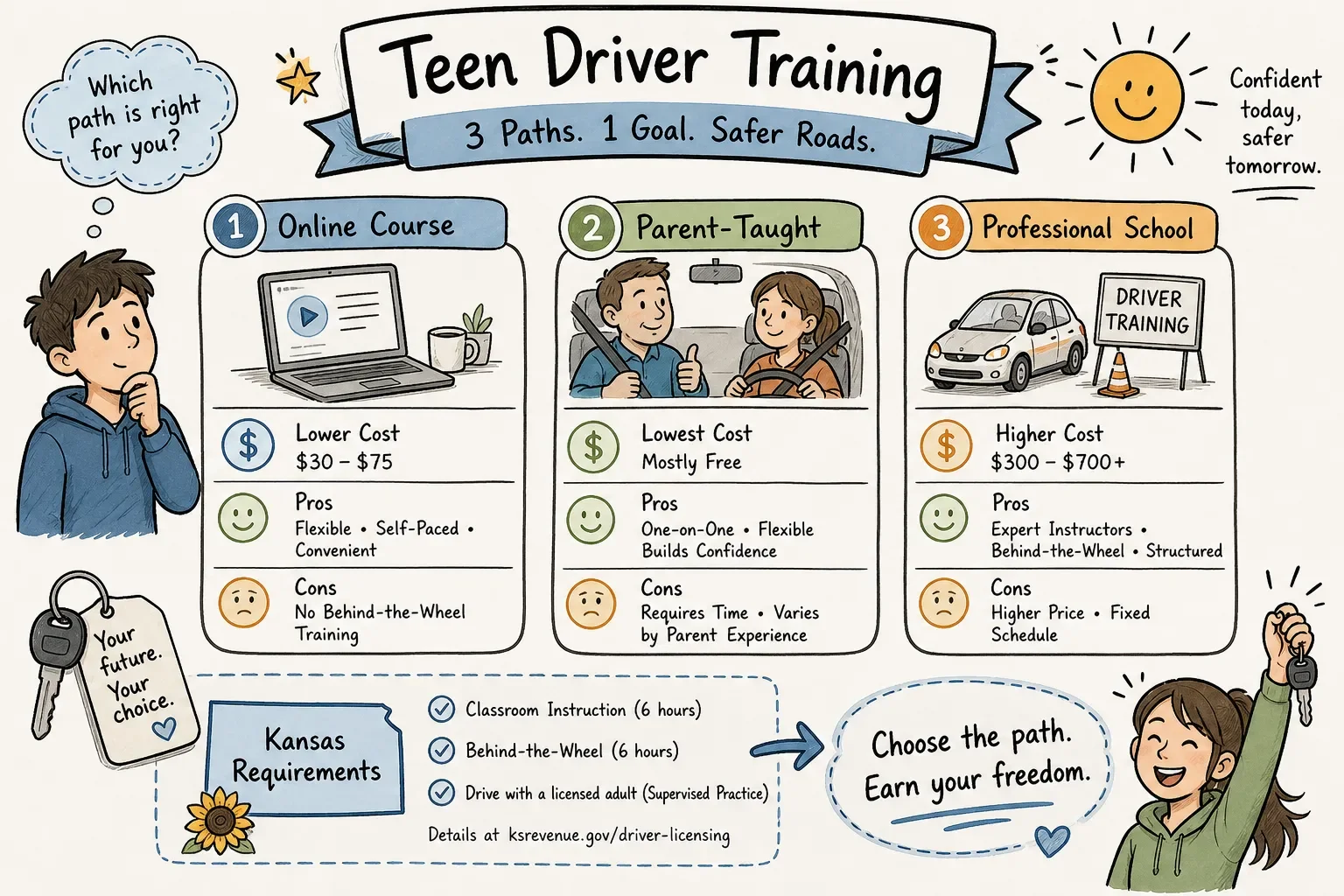
Teen driver training options compared: costs, pros & cons
Most parents assume picking a driver's ed program is simple. Then they start looking. Teen driver training options include online courses, in-person classes, parent-taught routes, hybrid programs, and private lessons, each with different price tags, time commitments, and levels of acceptance by the state DMV. What seems like a quick decision can turn into a frustrating detour.
At ICT North Star Driving Academy, one of the most common calls we receive is from parents who enrolled their teen in the wrong type of program and had to start over from scratch. It happens more than you'd expect. The families weren't careless. They just didn't know what to look for before they signed up.
This article breaks down every teen driving instruction pathway available, with real costs and honest comparisons, so you can make a confident choice the first time.
The four main teen driver training formats every parent should know
Before comparing cost or effectiveness, it helps to understand what each format actually is. These four categories cover every driver education format available to teens.
Online-only courses
These are state-approved theory courses completed at the student's own pace through a web browser. They cover traffic laws, road signs, and knowledge test prep. Completion time ranges from a few days to a few weeks depending on how much time the student puts in. Online courses do not include any in-car time. That component must be arranged separately.
Parent-taught programs
These combine an approved online curriculum with a parent or guardian serving as the behind-the-wheel instructor. This format is most formalized in states like Texas and Oklahoma, where parents must register as official instructors and follow a state-regulated process. Outside those states, "parent-taught" typically means supervised practice under general teen licensing laws, with no formal parent certification involved.
In-person classroom instruction
Traditional driver's ed classes are led by licensed instructors in a physical classroom setting. These include structured curriculum, live Q&A, and peer interaction. Whether behind-the-wheel training is included depends entirely on the school: some bundle it, some don't.
Hybrid or full-service programs
These programs bundle classroom instruction with scheduled behind-the-wheel lessons through the same school. This is the format most state DMVs recognize as a complete driver education program. It's also the most straightforward option for families who want one enrollment to cover all mandatory components.
What each teen driver training program actually costs
Cost varies widely across formats, and the cheapest upfront option is rarely the cheapest overall. Here's what families are actually paying nationally.
Online courses: low entry price, limited scope
Online driver's education for teens typically runs $38 to $110 nationally, and some state-mandated programs are free. The low cost is real, but it covers theory only. Families still need to arrange and pay separately for behind-the-wheel lessons, which average $40 to $80 per hour. A full BTW package covering the minimum required hours can total $500 to $800 on its own. Piecing together online theory plus private lessons often costs more than a bundled school program.
In-person and full-service packages
Traditional in-person driver's ed programs range from $375 to $600 nationally. In the Wichita area specifically, full programs from licensed schools typically run $390 to $450, which includes both classroom instruction and the required behind-the-wheel hours. For families who want a complete solution without coordinating multiple vendors, this range is competitive. Kansas also offers a Driver Education Reimbursement Program covering up to $200 of course costs for eligible students.
Parent-taught: low cost, high time investment
A parent-taught route can cost under $100 for the online course component. The real cost is time. Parents must log dozens of supervised driving hours with their teen, which works well for some families and is completely impractical for others. In Kansas specifically, the parent-taught route has significant limitations, more on that below.
How effective is each format, really?
The research is thinner than most people expect, but a few things are clear.
Knowledge outcomes and pass rates
A California study found no significant difference in knowledge outcomes between online and in-person students. Most states treat state-approved programs as equally valid for licensing purposes, and there's limited data isolating format as a variable in pass rates. From a pure knowledge standpoint, online and classroom instruction are roughly equivalent when the student completes the course seriously.
Real-world preparation: where the gap shows up
Online-only programs consistently fall short on hazard recognition and real-road decision-making. A student who completes an online course and logs hours with a parent has never received corrective feedback from a trained instructor. That gap matters most in the first six months of solo driving, which is statistically the highest-risk period for teen drivers. A licensed instructor can catch a dangerous habit in real time. A parent sitting in the passenger seat may not know what to look for.
Insurance discounts and teen defensive driving courses: verify before you assume
Some insurers offer discounts of 5% to 15% for teens who complete a state-approved driver's ed course. Providers like State Farm, GEICO, and Allstate commonly offer this, but policies vary by carrier and state. Certain insurers specifically require the program to include both classroom instruction and certified behind-the-wheel training to qualify. Teen defensive driving courses may also factor into discount eligibility with some providers. Families should call their provider before enrolling in an online-only course and assuming the discount applies, because it often doesn't. For an overview of how insurers treat driver's ed for discount purposes, see this guide to drivers ed car insurance discounts.
What Kansas requires before your teen gets a license
This is where format selection stops being abstract and becomes a practical checklist. Kansas has specific graduated driver licensing requirements that directly limit which programs count.
Minimum education and driving hour requirements
Kansas's graduated driver licensing requirements require teens to complete 8 hours of classroom driver education and 6 hours of professional behind-the-wheel training through a state-approved course. Beyond that, supervised driving hour requirements apply depending on age: 25 hours at age 15, and 50 hours (including 10 at night) at age 16. These are state minimums, not suggestions, and each requirement is documented separately at the DMV.
Supervised hours vs. professional BTW: a critical distinction
The supervised hours logged with a parent are entirely separate from the 6 mandatory BTW hours with a licensed instructor. Families conflate these two requirements regularly, which leads to teens arriving at the DMV without the right documentation. Parent supervision counts toward the 25- or 50-hour affidavit. It does not substitute for the professional behind-the-wheel requirement.
The Certificate of Completion and why it matters
Upon completing a state-approved program, teens receive a Certificate of Completion (the DE-99 form) accepted by the Kansas DMV as proof of driver education. This document can waive the written and driving tests, depending on the teen's age, and is required for the licensing process. Not every online course or informal arrangement produces this certificate. Only courses approved by the Kansas Department of Education or the Department of Finance and Administration qualify, which immediately eliminates many popular national online programs. For step-by-step licensing details and how the DE-99 fits into the process, see our Kansas teen drivers: the complete DMV permit guide, ICT North Star Driving Academy.
Why parent-taught training is harder to execute in Kansas
Parent-led instruction is a reasonable option in the right state. Kansas is not that state, not in any formal sense.
Where parent-taught programs are formalized
Texas and Oklahoma have structured Parent-Taught Driver Education programs with state registration requirements, specific driving log formats, and official certification for the parent instructor. These are well-defined, regulated programs. Outside those states, "parent-taught" typically means supervised practice under general teen licensing laws, with no formal parent certification and no equivalent completion certificate. For an example of how the Texas parent-taught program operates, read this guide on how parent-taught drivers ed works in Texas.
What this means for Kansas families
Kansas does not have a formal PTDE program. Parents can and absolutely should supervise practice driving, those hours fulfill the supervised driving affidavit requirement. But a Kansas teen cannot fulfill the 6-hour professional BTW requirement through parent supervision alone. Those hours must be completed with a licensed driving instructor. Parent involvement is essential; parent instruction is not a complete substitute.
Choosing teen driver training options in Kansas: how to pick the right program
Once you understand the format differences, the decision gets cleaner.
Three questions to ask any program before enrolling
Before signing up, confirm three things. First: does this program meet Kansas's 8-hour classroom and 6-hour BTW requirements? Second: will the teen receive a Certificate of Completion accepted by the Kansas DMV? Third: does the school use licensed instructors and a curriculum aligned with Kansas traffic laws? If the answer to any of these is unclear or no, keep looking.
Why a local, state-licensed academy simplifies the process
A full-service, locally licensed driving school eliminates the guesswork entirely. Families don't have to stitch together an online theory course, a separate BTW provider, and hope the documentation aligns with what the DMV needs. One enrollment covers all mandatory components under one roof, with one point of contact if questions come up. For a side-by-side look at local options, see our Best Driving School in Wichita, KS: 2026 Comparison, ICT North Star Driving Academy.
ICT North Star Driving Academy: built for Kansas teens
ICT North Star Driving Academy in Wichita delivers all of it in one program. Students receive:
8 hours of classroom instruction led by state-licensed instructors
6 hours of behind-the-wheel training using the IPDE method (Identify, Predict, Decide, Execute)
Flexible monthly class scheduling
Instructor pickup at home or school
A Kansas DMV-accepted Certificate of Completion
For Wichita-area families in Sedgwick County and surrounding communities, it's a direct path from enrollment to licensure, nothing left to figure out after the fact.
Frequently asked questions about teen driver training options
Do online-only driver's ed courses qualify in Kansas?
Most national online-only programs do not produce the DE-99 Certificate of Completion required by the Kansas DMV. Only courses approved by the Kansas Department of Education or Department of Finance and Administration qualify. Always verify state approval before enrolling.
Can parents teach their teen to drive in Kansas?
Parents can and should supervise practice driving hours, which count toward the supervised hour affidavit. However, Kansas does not have a formal Parent-Taught Driver Education program, so parent supervision cannot replace the 6 mandatory professional behind-the-wheel hours required by the state.
What are Kansas's graduated driver licensing requirements for teens?
Kansas teens must complete 8 hours of classroom instruction and 6 hours of professional BTW training through a state-approved program. Supervised practice hour requirements are 25 hours at age 15 and 50 hours (including 10 at night) at age 16, logged separately from professional BTW training.
Do teen defensive driving courses affect insurance rates?
Some carriers recognize teen defensive driving courses for discount purposes, but policies vary. Insurers like State Farm, GEICO, and Allstate may offer 5% to 15% discounts for completing a state-approved program, but many require both classroom and certified BTW hours to qualify. Call your provider before assuming any discount applies.
The bottom line on teen driver training options
There is no universally "best" format across all teen driver training options. But for Kansas teens who need to satisfy state requirements and walk into the DMV prepared, the clearest path is a state-approved program that includes both certified classroom instruction and documented professional BTW hours. Online courses are useful for supplemental knowledge. Parent supervision is essential for logging practice hours. Neither replaces a complete, state-licensed program.
Parents who want peace of mind and a clean paper trail should look for a local, licensed academy that handles both components under one enrollment. For families in the Wichita area and across Sedgwick County, ICT North Star Driving Academy is built to do exactly that. Visit the site to check the current class schedule, or call with questions before you sign anything elsewhere. You can also view upcoming sessions like the 8/15/2026 ICTNSDA Driver's Education Course, ICT North Star Driving Academy.
Kansas teen drivers: the complete DMV permit guide
The Kansas DMV teen driver permit process is straightforward once you know the exact sequence. Most families struggle not because the system is complicated, but because they show up at the examiner's office missing one document or misunderstanding which stage their teen is actually in. That single mistake sends them home and costs another trip.
This guide covers everything a Kansas DMV teen driver needs: the four GDL stages and their age thresholds, every document required at the counter, what the DE-99 certificate does and why it matters, what to expect from the vision and knowledge tests, the restrictions your teen must follow at each stage, and a checklist to verify the night before your appointment. Work through it once and the licensing process becomes a sequence you control rather than a mystery you navigate.
How Kansas's GDL system actually works for teen drivers
The four stages every teen and parent needs to know
Kansas uses a four-stage Graduated Driver Licensing (GDL) system. The progression runs from Instruction Permit at age 14, to Restricted License at 15, to a Less-Restricted License at 16, and finally to a Full License at 17. Each stage has its own minimum age, its own set of driving privileges, and its own requirements before moving forward. The system is designed to be sequential: you cannot skip a stage, and you cannot rush the hold periods.
The most commonly misunderstood rule is the 365-day hold requirement at every stage. Your teen must hold the Instruction Permit for a full year before advancing to the Restricted License, then hold the Restricted License for a full year before advancing, and so on. There are no shortcuts built in. The calendar matters as much as the paperwork.
Why the minimum age and hold period matter more than most teens expect
Here is a consequence most families do not realize until it affects them: a teen who turns 15 without an Instruction Permit falls under the age-16 entry rules rather than the standard age-14 progression. That means the one-year hold periods stack differently, and the teen may not reach a Full License until age 18 rather than 17. Missing the permit application early turns what feels like a minor delay into a year-long setback.
Kansas also offers a Farm Permit for 14- and 15-year-olds doing agricultural work, which requires parental approval and a signed affidavit certifying that 50 supervised hours have been completed prior to the teen's 16th birthday. If your teen does not qualify for that exemption, the standard four-stage sequence applies. The timing you start with determines everything downstream, so get the permit application done as close to age 14 as possible.
Kansas DMV teen driver document checklist
Proof of identity and Kansas residency
For identity, bring an original birth certificate, passport, or state-issued ID. The word "original" matters here. A photocopy of a birth certificate, even a certified-looking one printed at home, will not be accepted. The examiner's office needs the physical document, and families get turned away for this specific mistake more often than you would expect.
For residency, Kansas requires two separate documents showing your teen's name and a physical Kansas address. Acceptable options include utility bills, school transcripts or grade cards, insurance statements, W-2 forms, paycheck stubs, and mail from a government agency. If your teen is under 16 and does not have two documents in their own name, a parent or guardian can complete a Certification of Address by providing two of their own residency proofs along with a valid photo ID. A P.O. box does not count as a residential address on either document. For the official list of acceptable documents, see the Kansas Department of Revenue's guidance on proof of identity and residency: Kansas Department of Revenue's list of acceptable documents.
Parental consent, photo ID, and DMV fees
For any applicant under 18, a parent or legal guardian must be physically present at the DMV with a valid photo ID. The signed parental consent on the application is not something that can be completed at home and handed to the teen to bring in alone. The parent needs to be standing at the counter. This trips up families who assume a signed form is sufficient.
The fees break down as follows: $20 for the permit, $8 for the photo, and $3 for testing, totaling $31. Bring cash or verify accepted payment methods with your local examiner's office beforehand. The total is fixed, but payment flexibility varies by location.
How the DE-99 form changes your teen's entire DMV visit
What the DE-99 actually is and what it does for your teen
The DE-99 is the state-issued Certificate of Completion for an approved driver education course. It is not a form parents fill out, and it is not something you can download and self-certify. After your teen completes the classroom portion of a state-approved course and passes the Kansas Driver's Handbook test, the instructor submits the scores to administrative offices. The state then issues the valid DE-99 to the instructor within three business days. For specifics on state driver education application requirements, see the Kansas driver education application instructions: driver education application requirements.
At the DMV, the DE-99 replaces both the written knowledge test and the behind-the-wheel driving exam. The vision test is still required at every stage, but the two tests that most teens worry about are waived entirely. For teens who walk in without the DE-99, both tests must be passed on the spot. That is a meaningful difference in how your DMV visit goes.
Why completing a state-approved program makes the DMV visit simpler
At About, ICT North Star Driving Academy, students complete 8 hours of classroom instruction and 6 hours of behind-the-wheel training with a licensed instructor. That combination satisfies Kansas driver education requirements and produces the DE-99 certificate. Families who complete the program walk into the Kansas DMV with proof of course completion already handled. The written test is waived, the driving exam is waived, and the vision check takes a few minutes. Then you are done.
The DE-99 is a real requirement woven into Kansas's GDL system, and earning it through a state-licensed school is the most direct path through the process. There is no workaround that produces the same result at the DMV counter.
The supervised hours affidavit: what it is and who signs it
Separate from the DE-99, Kansas requires a parent- or guardian-signed affidavit certifying that the supervised practice hours have been completed. To obtain the Restricted License at 15, teens need 25 hours of supervised driving. To obtain the Less-Restricted License at 16, the requirement is 50 hours total, with at least 10 of those hours completed at night. Kansas provides a downloadable Teen Supervised Driving Log through the Department of Revenue's website, and parents should begin using it the day the permit is issued. Reconstructing hours from memory three months before a DMV appointment is harder than it sounds.
What to expect from the vision and knowledge tests
Kansas vision standards your teen must meet
The standard is 20/40 or better in at least one eye at the examination station. If your teen fails the standard screening, they will need a report from an ophthalmologist or optometrist showing 20/60 or better with or without corrective lenses. Kansas also has field-of-vision requirements: 35 degrees left and right, and 25 degrees above and below. If your teen wears glasses or contacts, bring them to the appointment. Vision is the one test that cannot be bypassed, even with the DE-99 in hand.
The written knowledge test: what is on it and how to avoid taking it
The Kansas knowledge test contains 25 multiple-choice questions pulled from the Kansas Driver's Handbook. Topics include traffic laws, road sign identification by shape and color, right-of-way rules, and safe driving decisions. To pass, a teen must answer at least 20 questions correctly, an 80% threshold. The test is not offered online before the DMV visit; if your teen needs to take it, it happens at the examiner's office on the day of the appointment.
The cleanest way to avoid the test entirely is to complete a state-approved driver education program and arrive with the DE-99. The exam is waived. No cramming the night before, no test anxiety at the counter. The handbook is still worth reading regardless, because understanding Kansas traffic laws is the point of the whole process.
GDL restrictions your teen must follow at every stage
Curfews and passenger limits that change by age
With an Instruction Permit at 14, a teen cannot drive alone under any circumstances. A licensed adult 21 or older must be in the front seat at all times. Because solo driving is not permitted at this stage, no nighttime curfew applies separately, the supervision requirement covers all hours.
At 15 with a Restricted License, solo driving is permitted only to and from school or work via a direct route. No non-sibling minor passengers are allowed in the vehicle, and solo driving between 9 p.m. and 5 a.m. is prohibited. At 16 with a Less-Restricted License, solo driving is allowed between 5 a.m. and 9 p.m., with one non-sibling passenger under 18 permitted. After the first six months at this stage, the nighttime curfew lifts. At 17 with a Full License, all GDL restrictions are removed.
For the official breakdown of Kansas GDL rules, consult the state's guidance on Graduated Driver Licensing: Kansas GDL rules.
Wireless device and seat belt rules that apply from day one
No wireless communication device use is permitted for any driver ages 14 through 16, except to report an emergency or illegal activity. This restriction applies at every GDL stage before the full license, including when a licensed adult is present in the vehicle. It is not a suggestion and it is not negotiable. Seat belts are mandatory for all teen drivers, and violations carry a $60 fine. Both rules take effect the moment the permit is issued. For a concise third-party summary of Kansas GDL and restrictions, see this overview of Kansas graduated driver licensing laws: Kansas graduated driver licensing laws.
The pre-appointment checklist: verify this the night before
Kansas DMV teen driver documents to confirm in advance
Original birth certificate or passport (proof of identity)
Two Kansas residency documents showing a physical address
Parent or legal guardian present with a valid photo ID
Signed parental consent on the DMV application form
DE-99 Certificate of Completion (if driver's education is complete)
Kansas Teen Supervised Driving Log with parent signature (required for Restricted or Less-Restricted license applications)
$31 in fees ($20 permit, $8 photo, $3 testing)
Mistakes that send families home without a permit
Missing one residency document is the most common reason families leave the examiner's office empty-handed. The second is the parent forgetting their own photo ID. A photocopy of the birth certificate instead of the original is another reliable way to waste the trip. Showing up before the 365-day hold period is complete, or arriving without the DE-99 and being unprepared to take the written test, round out the list. None of these mistakes are hard to avoid with a five-minute document check the evening before.
The permit is just the starting point
The Kansas teen licensing process is a sequence, and every stage has a clear checklist. Families who prepare correctly get through each DMV visit in one trip. Families who show up and find out they are missing something go home and schedule another appointment. The difference is usually one document or one misunderstood rule.
Start the supervised driving log the day the permit is issued. Do not wait until the next DMV appointment is approaching. Fifty hours logged casually over a full year is manageable. Fifty hours compressed into two months is stressful for everyone, and the quality of practice suffers.
If your teen has not yet completed driver's education, that single step simplifies more of the Kansas DMV teen driver requirements than anything else on this list. Completing the program waives both the written test and the driving exam, the classroom hours cover Kansas-specific traffic laws, and the behind-the-wheel time counts toward the supervised practice requirement. For details on obtaining a Kansas learner's permit, including the steps to apply and required documents, see this guide on how to get your learner's permit in Kansas: how to get your learner's permit in Kansas.
For Wichita-area families, ICT North Star Driving Academy offers a state-approved program with flexible scheduling, instructor pickup at home or school, and the DE-99 Certificate of Completion your teen needs to walk into the DMV fully prepared. To schedule classes, visit the Appointments, ICT North Star Driving Academy page, or if you have questions about availability and logistics use the Contact, ICT North Star Driving Academy page.